
and what Italians really mean by them
Listen to two Italians chatting at a bar and you will hear something that no textbook dialogue prepares you for: Italian filler words. Sentences start with allora, change direction with cioè, slow down with diciamo and end with insomma… or just with a shrug and a boh.
These little words have a name. In Italian we call them intercalari, or more technically segnali discorsivi (discourse markers). On their own they often mean very little. In real conversation, though, they do a lot of work: they give the speaker a moment to think, they help the listener follow, and they add attitude to what is being said.
Many learners at intermediate level can build correct sentences but still sound “like a book” when they speak. Very often the missing piece is not grammar or vocabulary. It is these small words. In this article you will find the most common Italian filler words, grouped by what they do, plus a few words that change meaning depending on how you say them.
Why Italian filler words matter
Nobody speaks in a perfect, continuous stream, in any language. Native speakers pause, hesitate, correct themselves and go back. The difference is that they rarely leave an empty silence: they fill it.
This is exactly why filler words are useful for learners too. If you stop in silence while you search for a word, you sound stuck. If you say “allora… diciamo…” in the same pause, you sound like someone who is thinking in Italian. The pause is the same, but the impression is completely different.
The Italian linguist Carla Bazzanella, in her entry on discourse markers for the Treccani Enciclopedia dell’Italiano, describes these words as a group defined by their function, not by their grammar. That is a useful way to learn them. Just like many Italian idioms that don’t translate, filler words make little sense word by word: instead of memorising a translation for each one, it is better to understand what job it does in the sentence.
The most common Italian filler words, by function
You don’t need to learn all of them. Read through the groups, notice which ones you already hear in films, podcasts or conversations, and start from those.
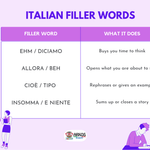
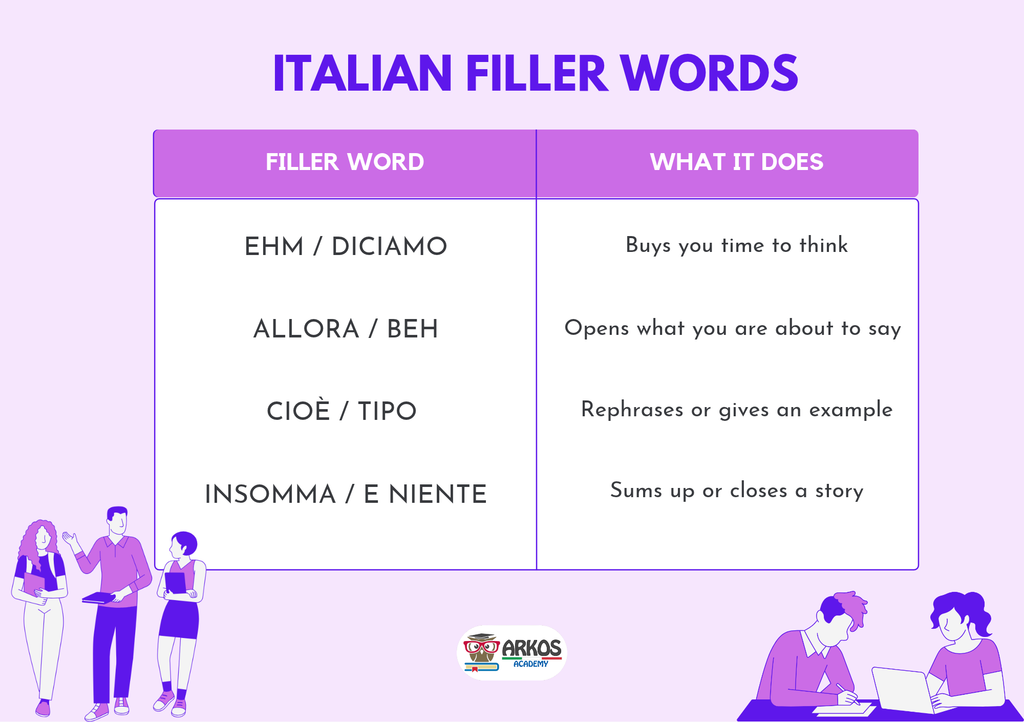
Filler words to buy time
These are the words Italians use when the next idea is not ready yet.
- Ehm, eh, mmh: the Italian versions of “um” and “uh”. You can stretch them as much as you need: “Ehmmm…”
- Diciamo: literally “let’s say”. It gives you a moment to choose a word, and it also softens what follows. “È stata, diciamo, una giornata intensa.” (It was, let’s say, an intense day.)
- Come dire: “how can I put it”. Perfect when you are looking for the right word: “Lui è… come dire… un po’ particolare.”
Allora also belongs here when you stretch it while thinking: “Allooora…”
Filler words to start speaking
Italians very rarely jump straight into a sentence. They open with a small word first.
- Allora: the most common opener of all. “Allora, cosa facciamo stasera?” (So, what are we doing tonight?)
- Dunque: similar to allora, but it sounds a little more thoughtful. You hear it often when someone is about to explain something step by step.
- Beh: a short form of bene (also written be’). It works like “well” at the start of an answer: “Beh, dipende.” (Well, it depends.)
- Ecco: it points at what is coming next, a bit like “here’s the thing”: “Ecco, il problema è questo.”
Filler words to rephrase or explain
These words appear when the speaker wants to correct, clarify or simplify what they just said.
- Cioè: literally “that is”, but in speech it works like “I mean”. “Arrivo alle sei, cioè, forse alle sei e mezza.” Be careful: when it is said quickly, cioè can sound very similar to c’è (there is).
- Nel senso: “in the sense that”, “what I mean is”.
- Praticamente: literally “practically”, but it is mostly used like “basically”. “Praticamente abbiamo perso il treno.”
- Tipo: the Italian “like”. It introduces an example or an approximation: “Erano tipo le tre di notte.” (It was like three in the morning.)
Filler words to close or sum up
When a story or an explanation is coming to an end, these words announce it.
- Insomma: “in short”, “all in all”. It wraps up a thought: “Insomma, è andata bene.”
- E niente: very common at the end of a story, especially after something a bit disappointing: “E niente, alla fine siamo tornati a casa.”
- Comunque: “anyway”. It brings the conversation back to the main point after a digression.
- Vabbè: from va bene. It means “oh well”, “never mind”, and it often closes a topic with a touch of resignation.
Filler words to show your attitude
Some filler words don’t organise the sentence: they show how you feel about it.
- Mah: doubt or scepticism. “Mah, non sono sicuro.” (Hmm, I’m not sure.)
- Boh: “I have no idea”. It is often a complete answer on its own, usually with a shrug. If you are curious about the gestures that go with these words, have a look at our guide to Italian hand gestures.
- Dai: we will see it below, because it has more than one meaning.
Filler words to involve the listener
Italian conversation is very interactive, and some fillers exist only to keep the other person “inside” the talk.
- Guarda and senti: literally “look” and “listen”. They call the other person’s attention: “Guarda, secondo me hai ragione.” Remember that these are the informal tu forms. With someone you address as Lei, they become guardi and senta. If you are not sure when to use one or the other, read our guide to tu or Lei in Italian.
- Sai: “you know”.
- No? and capito? at the end of a sentence, to check that the listener is following: “È più facile così, no?”
Want to train your ear to catch these words in real Italian? In our Free Library you will find free materials to practise with authentic language.
Italian filler words with more than one meaning
Most Italian filler words have one main job. A few of them, however, change meaning completely depending on the context and, above all, on the intonation. These are worth a closer look.
Allora
- At the start of a sentence, it opens the conversation: “Allora, come stai?”
- In the middle of a sentence, it introduces a consequence, like “then” or “in that case”: “Se piove, allora restiamo a casa.”
- Alone, as a question, it shows that you are waiting for an answer, sometimes with a bit of impatience: “Allora?” (Well? So?)
Insomma
- To sum up: “Insomma, abbiamo deciso di partire.”
- As an answer to “Come stai?”, a hesitant “Insomma…” means “so-so”, not great.
- Said with force, “Insomma!” expresses impatience, like “come on, that’s enough!”
Here the tone of voice makes all the difference. If you want to understand how melody changes meaning in Italian, read our article on Italian intonation.
Cioè
- To rephrase: “Ci vediamo domani, cioè, dopodomani.”
- As a question, “Cioè?” asks the other person to explain: “What do you mean?”
Dai
- To encourage: “Dai, che ce la fai!” (Come on, you can do it!)
- To show surprise or disbelief: “Ma dai!” (No way! Really?)
- To push someone to decide or to close a discussion: “Dai, andiamo.”
Beh
- At the start of an answer, it means “well”: “Beh, potrebbe funzionare.”
- Alone, with a questioning tone, it expresses perplexity or a small objection: “Beh?” (So what? And?)
Filler words are natural, but too many say something about you
Italians use filler words constantly, and nobody notices them when they come at the right moment. The problem starts when they stop being a tool and become a habit.
In fact, the Italian word intercalare also describes exactly this: a word that someone repeats out of habit, sometimes in every sentence. And native speakers do notice. As an article in Il Post pointed out, cioè in particular has long been seen as a sign of imprecision or poor expression. A speech full of ehm, cioè and tipo is simply harder to follow.
When a filler word appears too often, the listener perceives something else behind it: lack of confidence, shyness, or a limited vocabulary. This is true for native speakers, and it is true for learners.
A few simple rules can help:
- Choose two or three filler words and make them yours, instead of trying to use all of them.
- Vary them. The same word in every sentence becomes a tic.
- Don’t stack them. “Allora, cioè, praticamente, tipo…” doesn’t buy you more time, it just makes the sentence heavier.
- Accept a short silence now and then. A calm pause can sound more confident than a filler word.
The best way to find the right balance is to listen. When you watch an Italian film or series, try to notice which filler words each character uses and when. Our guides on listening in Italian and on how to improve Italian with movies can help you do this in a structured way.
Not sure if your Italian is ready for real conversations? Take our free level test and find out where you are.
From correct Italian to natural Italian
Filler words are small, but they are one of the clearest differences between Italian that is correct and Italian that sounds natural. The same gap exists in reading, too: textbook Italian and the Italian that Italians write for each other are not the same thing, as we explain in how to read Italian written for Italians. Start with the filler words that feel closest to you, listen for them everywhere and use them until they come out automatically.
Knowing which filler fits which moment, and feeling how a real conversation breathes, comes with practice and with someone who can listen to you and give you feedback. If you want to work on your spoken Italian with a teacher, discover our private lessons and packages.