

Some Italian idioms can leave you completely lost the first time you hear them. You know every single word, the grammar is simple, and still the sentence makes no sense at all.
Imagine you’re about to take an exam in Italy. An Italian friend smiles and says: “In bocca al lupo!” Your brain does what brains do: it translates. Bocca is mouth, lupo is wolf. So your friend just wished you to end up in the mouth of a wolf… before an exam?
Of course not. It means “good luck”, and the right answer is “Crepi!” (literally “may it die”, meaning the wolf). But that moment of confusion is something every learner of Italian knows very well. In this guide we’ll look at a few Italian idioms and proverbs that collapse in translation, what they really mean, when Italians use them, and the culture hiding behind each image.
Why Italian idioms don’t translate word by word
When you learn a language as an adult, your brain uses what it already has. You know acqua (water) and you know bocca (mouth), so when you hear acqua in bocca you put the pieces together and get “water in the mouth”. The grammar is fine. The words are right. And the meaning is completely gone.
This happens because idioms don’t work like normal sentences. In a normal sentence, the meaning comes from the words. In an idiom, the meaning comes from a shared story: something people saw, lived or laughed about for generations, until a short image was enough to recall the whole idea. An idiom is not the sum of its words. It is culture compressed into one sentence.
That’s why a simple list of Italian idioms with their English equivalents only takes you halfway. It tells you what to say instead, but not when an Italian would say it, with what tone, or why the image makes sense to them. Without the why, idioms are hard to remember and even harder to use at the right moment.
So let’s start with the most famous one.
L’abito non fa il monaco: why a monk and not a book?
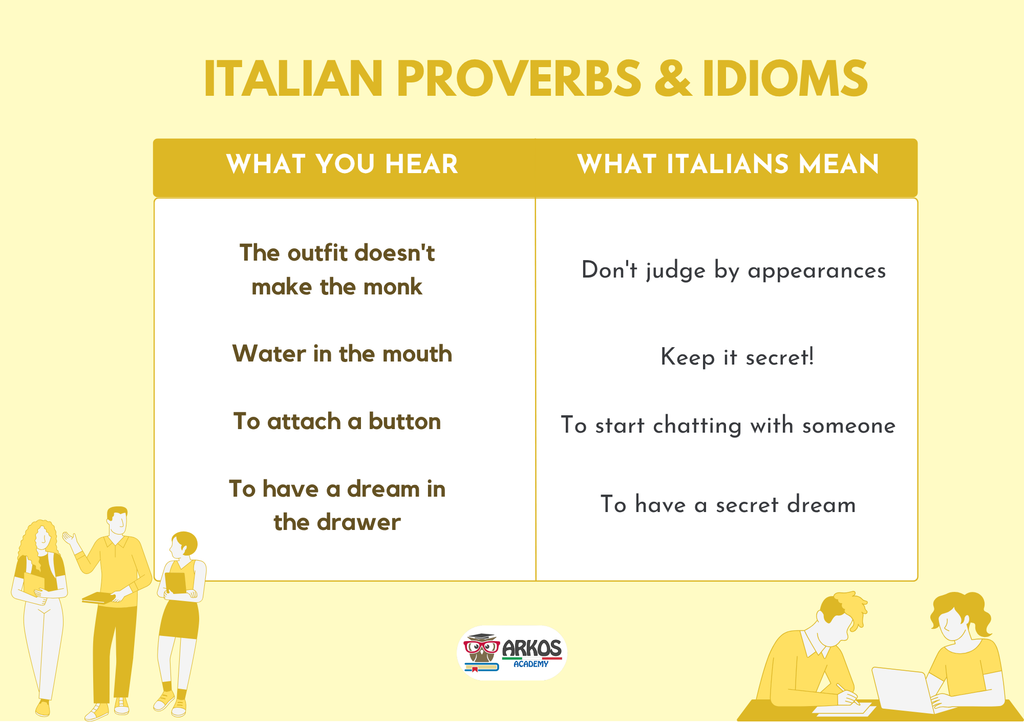
L’abito non fa il monaco literally means “the habit doesn’t make the monk”. In everyday Italian abito means a dress or a suit, but here it’s the long robe that monks wear.
The meaning is close to the English “don’t judge a book by its cover”: appearances can be misleading, and what someone wears tells you nothing certain about who they really are.
This is easy. The real question, the one many learners ask, is a different one: why a monk? English chose a book. Italian chose a man in a robe.
Why Italian chose the monk
For centuries, the Italian peninsula was full of monasteries, convents and religious orders: Benedictines, Franciscans, Dominicans and many others. Monks and friars were part of daily life, in the cities and in the countryside, and their robe was probably the most recognizable “uniform” of the time.
The habit was not just a piece of fabric. It was a social signal. It told people that this man had given his life to prayer, that he could be trusted, that he deserved respect and maybe some help. A person wearing a habit could knock on doors, ask for food and be welcomed.
And this is exactly why the habit could also be used to deceive. Italian literature is full of men who wore the robe without living the life. In Boccaccio’s Decameron, written in the 14th century, several stories make fun of friars whose holy clothes hide very unholy behavior. Frate Cipolla, who tricks a whole village with fake relics, is one of the most famous.
So when Italians say l’abito non fa il monaco, they’re using an image that was clear to everyone for hundreds of years: the robe gives you the look of a holy man, not the holiness.
From Latin to Italian (and to English too)
The proverb didn’t start in Italian. It comes from medieval Latin: cucullus non facit monachum, “the hood doesn’t make the monk”. From Latin it moved into several European languages, and French still says l’habit ne fait pas le moine. If you’re curious about how Latin slowly turned into the Italian we speak today, you can read more in our article on the evolution of the Italian language.
Here’s the surprise for English speakers: English had the monk too. Shakespeare uses the Latin version in Twelfth Night and in Measure for Measure, and “the cowl does not make the monk” was once an English saying. Over time it disappeared, and the book took its place. Italian, on the other hand, kept the monk.
You may also read that the proverb was born with Alessandro Manzoni, because one of his characters uses it in I promessi sposi (The Betrothed). Manzoni certainly made it even more familiar to Italian readers, but the saying is much older than his novel.
A legend from Monaco
There’s also a popular story that some people connect to the proverb, even though it’s a legend and not the real origin. In 1297, Francesco Grimaldi, a nobleman from Genoa, disguised himself as a Franciscan friar to get inside the fortress of Monaco. Once inside, he opened the gates to his men and took the castle. The Grimaldi family still rules Monaco today, and two monks holding swords still appear on its coat of arms.
A fake monk, a stolen castle and a place called Monaco: the coincidence is almost too perfect. Just remember that the Latin proverb already existed.
How Italians use it today
Today the proverb is used in very ordinary situations, often with a light tone:
Sembra un tipo severo, ma è simpaticissimo. L’abito non fa il monaco!
(He looks strict, but he’s really nice. Don’t judge by appearances!)
Ha una macchina di lusso, ma non paga mai i fornitori. L’abito non fa il monaco.
(He drives a luxury car, but he never pays his suppliers. Appearances can be misleading.)
Italians also like to flip it. L’abito fa il monaco, “the habit does make the monk”, is sometimes said with irony, for example about job interviews, where looking the part can matter more than it should.
Want more Italian explained with its culture, not just its grammar? Explore the free materials in our Free Library.
Acqua in bocca: Italian idioms for keeping a secret
Literally: “water in mouth”. A learner hearing it for the first time might think of a dentist, or of someone who is very thirsty.
In reality, acqua in bocca means “keep it secret, don’t say a word”, similar to “mum’s the word” or “my lips are sealed”. Italians say it right after sharing something confidential, often together with mi raccomando (“please, I’m counting on you”). Like many Italian idioms, it often travels with a gesture: a finger on the lips. You can find more about this side of the language in our guide to Italian hand gestures.
Stiamo organizzando una festa a sorpresa per Marco. Acqua in bocca, mi raccomando!
(We’re organizing a surprise party for Marco. Not a word, okay?)
Why water? The logic is physical: you can’t speak with a mouth full of water without spilling it. There’s also a popular story behind it. A woman who could not stop gossiping went to a priest for help. He gave her a bottle of water and told her to fill her mouth every time she felt like speaking badly about someone. It’s a story, not a historical document, but it explains why the expression has a slightly “moral” flavor.
Attaccare bottone: sewing a conversation?
Literally: “to attach a button”. A learner pictures a needle and thread. But attaccare bottone means to start a conversation with someone, usually a stranger.
The tone can change a lot. Sometimes it describes someone who stops you and talks for ages, and Italians even have a noun for this person: un attaccabottoni. Other times it describes a friendly or flirty approach:
Quel signore attacca bottone con tutti, anche in ascensore.
(That man starts chatting with everyone, even in the elevator.)
Ieri al bar ho finalmente attaccato bottone con quella ragazza.
(Yesterday at the bar I finally started talking to that girl.)
As with many Italian idioms, the origin is not certain. One theory points to tailors, who chatted with their customers while sewing buttons onto their clothes. Another goes back to old medicine, when doctors closed wounds with a hot iron tool with a button-shaped tip… painful, like a conversation you can’t escape. Interestingly, English has a cousin: “to buttonhole someone” means to stop a person and keep them talking. Different button, same idea.
Avere un sogno nel cassetto: one of the sweetest Italian idioms
Literally: “to have a dream in the drawer”. Translated word for word, it sounds a bit strange, as if you could fold a dream and put it away with your socks.
In fact, that’s almost the idea. A sogno nel cassetto is a secret wish or ambition you keep for yourself, waiting for the right moment:
Il mio sogno nel cassetto è aprire una piccola libreria.
(My secret dream is to open a small bookshop.)
Why a drawer? Because it’s where people traditionally kept private, precious things: letters, photos, documents. Things you don’t throw away, but don’t show to everyone. The dream is not forgotten. It’s safe, and it’s waiting.
Be careful with English “equivalents”. A pipe dream is something unrealistic, and a bucket list is a list of things to do before you die. A sogno nel cassetto is more tender: a real hope, maybe even possible, kept private. That’s why Italians often ask “Qual è il tuo sogno nel cassetto?” in interviews or when they want to know someone better.
L’erba voglio: the plant nobody can grow
The full version is l’erba voglio non cresce nemmeno nel giardino del re. Literally: “the ‘I want’ grass doesn’t grow even in the king’s garden”. A learner might reasonably ask: what kind of plant is voglio?
It isn’t a plant at all. Voglio means “I want”, and the proverb turns it into the name of a herb. The message is simple: if not even the king can grow it, you certainly can’t have everything you want.
Many Italian idioms are learned at home, long before school, and this is a perfect example. Parents and grandparents say it to children who repeat voglio, voglio, voglio a little too often. For this reason, adults hear it with a family, slightly nostalgic feeling, and they also use it with each other, with a smile, when someone is being demanding. It’s also a hidden lesson in politeness: in Italian, asking with vorrei (I would like) sounds much softer than voglio, as explained in our article on Italian modal verbs.
Chi fa da sé fa per tre: when Italian idioms contradict each other
Literally: “who does by himself does for three”.
The meaning is: if you do something yourself, it gets done better and faster than if you wait for others. The closest English idea is “if you want something done right, do it yourself”.
Italians use it half proudly and half resigned, usually after someone let them down:
Ho aspettato l’idraulico per una settimana. Alla fine l’ho aggiustato io. Chi fa da sé fa per tre!
(I waited a week for the plumber. In the end I fixed it myself. If you want something done…)
There’s a nice cultural twist here. Italian also has the opposite proverb: l’unione fa la forza, “unity is strength”. Proverbs contradict each other all the time, in every language. They’re not laws: they’re tools for a specific moment. Knowing which one fits the moment is the real skill, and it’s something you learn from context, not from a dictionary.
Hear how these expressions really sound. Watch the full Italian proverbs playlist on YouTube, with more proverbs and idioms explained in Italian.
Why Italian idioms live in conversation, not in lists
A book or a list gives you idioms one at a time, isolated and still on the page. In real life, native speakers mix them into conversation all the time: in the middle of a story, in a joke, in a complaint about the plumber. They come with a tone of voice, a face, sometimes a gesture. That’s where you really understand when to use them.
So when you meet new Italian idioms, try to remember the situation and not only the translation. Ask yourself why this image makes sense to Italians. Listen for idioms in real speech, for example with the strategies in our guide to listening in Italian or while you improve your Italian with movies. And when you feel ready, use one in a real conversation. The first time is the hardest.
Italian idioms are often the last step between “speaking correct Italian” and “speaking like an Italian”. If you’d like to know where you are on that road, you can start with our free Italian level test. And if you want to practice expressions like these in real conversation, with someone who can explain the culture behind them, have a look at our private lessons.


1 commento su “Italian idioms and proverbs you can’t translate literally”
I commenti sono chiusi.