
You read a lot in Italian. Stories, blog posts, maybe a whole book. You understand most of it, you enjoy it, you turn the pages. And then, a week later, you try to say something similar in a conversation… and nothing comes out. The words you read so many times are not there when you need them.
This is one of the most common frustrations at intermediate level, and it doesn’t mean that reading is useless. It means that, past a certain point, the way you read matters as much as how much you read. In this guide we’ll look at the difference between passive and active reading in Italian, why it matters so much for adult learners, and a simple method to make what you read actually stay with you.
Why reading a lot isn’t always enough for adults
Many learners dream of learning Italian the way children do: no rules, no effort, just soaking it up. And the instinct is not wrong. Children really do learn their first language by absorbing it.
But an Italian child absorbs Italian for every waking hour of every day, for years. An adult learner usually has a few hours a week, if things go well. You can’t compress thousands of hours of immersion into one or two evenings a week and expect the same result.
The good news is that adults have something children don’t have: the ability to reason. You can notice a pattern, give it a name, compare it with your own language and remember why it works. A child can’t do that. You can.
So the real question is not “how can I read like a child?”, but “how can I read like an adult who wants to learn?”. The answer is active reading in Italian.
Passive vs active reading in Italian
If you’ve read our guide to listening in Italian, you already know the difference between passive and active listening. Reading works the same way. Think of a train journey. Passive reading is like looking at the landscape from the window: you see everything go by, it’s pleasant, and afterwards you couldn’t describe a single tree. Active reading is getting off the train and walking through the same landscape. It’s slower, but now you know where you’ve been.
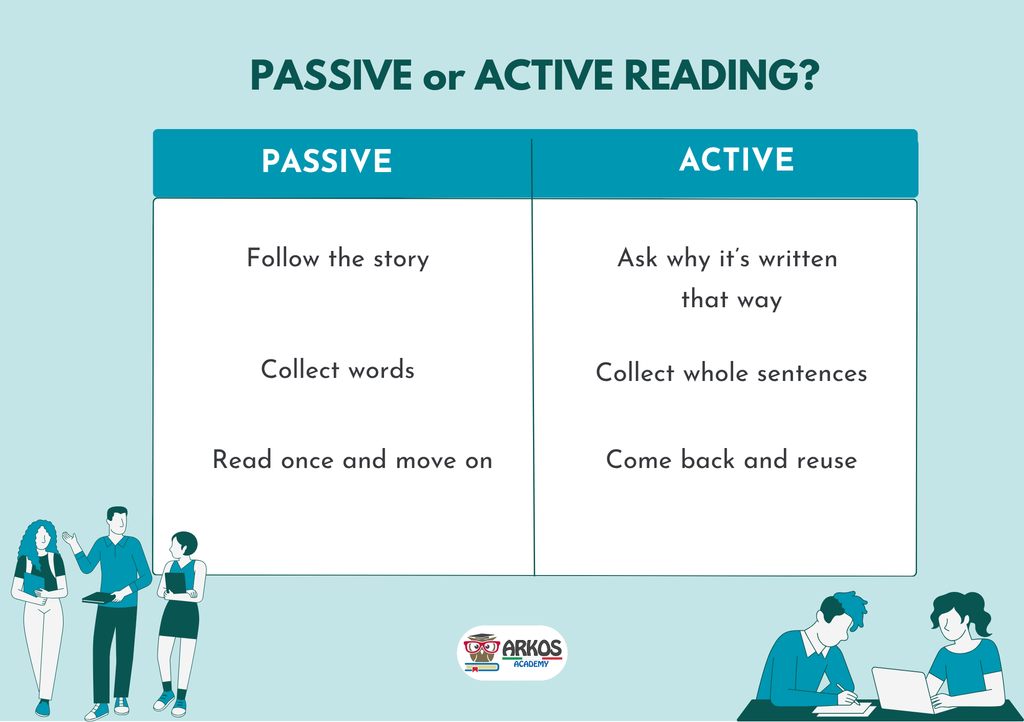
In practice, passive reading means letting the words wash over you. You follow the story, you skip what you don’t understand, and you move on. This is still useful: it builds fluency and confidence. Active reading in Italian, on the other hand, means reading with questions in your head. You stop, you look closely at a sentence, and you ask yourself why it was written that way.
You don’t need to read everything actively. Most of the time, a mix works best: a lot of relaxed reading for pleasure, and a few short passages read slowly and carefully.
And here’s an interesting consequence. Reading for pleasure works best with texts where you understand almost everything, otherwise you get tired and give up. Active reading is different: because you work slowly on a short passage, you can choose a text that is a little above your level, the kind you would usually call “too difficult”. As long as you recognize part of it, you have something to work with. A little above your level, though, not far above: if you can’t recognize anything, there’s nothing to analyze, only frustration. A few lines are enough.
Active reading in Italian is not just about vocabulary
When people think about learning from reading, they usually think about new words. You underline them, look them up, maybe write them in a list. That’s useful, but it’s the easy half.
The real work is noticing how the sentence is built. Researchers in language learning have discussed this for decades: the linguist Richard Schmidt suggested in 1990 that learners make progress above all on what they consciously notice in the language they read and hear. Later he softened the idea, saying that noticing is not always strictly necessary, but that it clearly helps. For an adult with limited time, that help makes a big difference.
So, while you read, try to ask three questions:
- Why this tense? Why is this verb in the imperfetto and not in the passato prossimo? What would change if you swapped them?
- Why this word order? Why did the writer put this word first, when you expected it later?
- What is this sentence really saying? What is the idea underneath the words, and what does the writer want you to feel or think?
These questions turn grammar from a table you memorised into something you can see working in a real text.
Active reading in practice: a famous opening
Let’s try with one of the most famous openings in Italian literature, from Il fu Mattia Pascal (The Late Mattia Pascal), the novel Luigi Pirandello published in 1904.
Don’t worry if you don’t understand every word: you’re not supposed to. Active reading in Italian doesn’t start from what you don’t know, but from what you can recognize. A verb ending, a pronoun, a name, a line of dialogue: each one is a piece of information you can work with. Read the passage once and notice what you recognize. Then use the notes below.
The passage
Una delle poche cose, anzi forse la sola ch’io sapessi di certo era questa: che mi chiamavo Mattia Pascal. E me ne approfittavo. Ogni qual volta qualcuno de’ miei amici o conoscenti dimostrava d’aver perduto il senno fino al punto di venire da me per qualche consiglio o suggerimento, mi stringevo nelle spalle, socchiudevo gli occhi e gli rispondevo:
“Io mi chiamo Mattia Pascal.”
“Grazie, caro. Questo lo so.”
“E ti par poco?”
Help with the text
- ch’io = che io · de’ miei = dei miei · ti par = ti pare (old-fashioned forms)
- il senno = good sense, judgement
- d’aver perduto = di aver perso
- stringersi nelle spalle = to shrug
- socchiudere gli occhi = to half-close your eyes
- E ti par poco? = And you think that’s nothing?
A passive reader smiles and moves on. An active reader stops and asks the three questions.
The tenses
You may not know senno or socchiudere, but you can probably recognize the endings -ava, -avo, -evo. That’s enough to start.
Look at the series dimostrava, mi stringevo, socchiudevo, rispondevo: all imperfetto. Why not the passato prossimo? Because of ogni qual volta (whenever). This is not something that happened once: it happened again and again, it was a habit. If it had happened only once, the sentence would change completely: un giorno un amico è venuto da me e io gli ho risposto… In a novel you would often find the passato remoto for a single event, while in everyday spoken Italian you would use the passato prossimo. Either way, it’s no longer a habit but a single moment.
Now look at the name. The narrator writes mi chiamavo Mattia Pascal (my name was), but in the dialogue he says mi chiamo (my name is). Why the imperfetto, if a name doesn’t change? This is the most interesting question of the whole passage, and the answer is in the next section.
If you want to review how these two past tenses divide the work, read our guide to passato prossimo vs imperfetto.
The word order
The first sentence makes you wait. Una delle poche cose… era questa: the word questa announces something, and only after the colon do you discover what it is. The most important information, the name, arrives at the very end.
Then there’s Questo lo so. In English you’d say “I know this”, but Italian puts questo first and then repeats it with the pronoun lo. It’s very common in spoken Italian: the speaker first puts the topic on the table (“this…”) and then says what he thinks about it (“…I know it”). The tone is almost impatient: “yes, yes, that I already know”.
And in me ne approfittavo, the little word ne refers back to the fact of being called Mattia Pascal. Our article on ci and ne in Italian explains how these small words carry whole ideas.
What the passage is really saying
On the surface, it’s a joke. Friends come to Mattia for advice, and his only answer is his own name. But look closer. A friend has to aver perduto il senno, to have lost his mind, to ask him for advice: the narrator is laughing at himself. The only thing he knows for certain is his name, and he uses even that as a joke.
Then think about the title: Il fu Mattia Pascal. Il fu is used for someone who has died, “the late”. That explains the imperfetto mi chiamavo: it was true then, but it’s no longer true now. A few lines later, Pirandello confirms it, when Mattia says that at the time he didn’t know what it meant to no longer be able to answer, as before, “my name is Mattia Pascal”. In just four lines, a small joke announces the big theme of the novel: what happens to a person when even the one certainty about who he is disappears?
This is what active reading in Italian gives you: not just the words, but the meaning hiding inside the grammar.
Curious about which texts suit your level? Take our free Italian level test and find out where you are today.
A four-step method for active reading in Italian
You don’t need hours for active reading in Italian. A short passage, ten or fifteen minutes, and a notebook are enough.
Step 1: read for meaning
Read the passage once, without stopping. Don’t look anything up. The goal is to understand the general idea: who, what, where, what tone. This first reading is passive on purpose.
Step 2: work with what you recognize
Now read it again, slowly. Don’t start from the words you don’t know: start from what you recognize. A tense, a pronoun, a familiar construction. Ask the three questions about those: why this tense, why this order, what is it really saying? Look up only the words that block the meaning, and underline the structures that surprise you.
Step 3: collect sentences, not words
Instead of writing single words in a list, copy two or three whole sentences that you liked or found interesting. A word alone is easy to forget. A word inside a sentence comes with its grammar, its prepositions and its context. Next to each sentence, write one short note: “imperfetto for a habit”, “object first, then repeated with lo”, and so on.
Step 4: come back and reuse
A few days later, reread your sentences. Then try to use them: change one detail, write a sentence about your own life with the same structure, or say it aloud. Una delle poche cose che so di certo è questa: che… can become Una delle poche cose che so di certo è questa: che il caffè al bar è sempre più buono. This is the moment when reading turns into speaking and writing.
If you like to plan your study time, this method fits well into short sessions, as we explain in our article on learning Italian with time blocking. And if you’re still looking for the right texts to start with, have a look at our guide on how to read Italian written for Italians.
When grammar turns into instinct
Active reading in Italian is not easy, and it’s not supposed to be. It’s slower and it asks for attention. But it’s the most logical next step once you have read enough: the effort is exactly what turns reading into progress instead of scenery.
Something important happens when you read this way. All the separate things you have studied… tenses, word order, vocabulary… stop living in different chapters of your textbook. They meet in the same sentence, and slowly they become one thing. That’s when knowledge turns into instinct, and the right tense or the right word order starts to come out on its own when you speak.
For free materials to practise your reading, visit our Free Library. And if you’d like someone to read with you, help you notice what matters and turn it into real conversation, take a look at our private lessons.