
It usually happens at a random moment. You’re waiting for a train, you open an Italian website on your phone, and you start reading. You know the words. Almost all of them. No strange verbs, nothing you would need to look up. And still you have no idea what the sentence is saying.
You read it again, and nothing changes. So you close the page with a very specific feeling: not confusion, exactly, but something closer to betrayal. All those hours of study, and you can’t read Italian written for Italians…!
If this has happened to you, you’re not alone, and your Italian is not the problem. This experience is extremely common at intermediate level, and it has a clear explanation. In this guide we’ll look at why it happens, what really changes when Italians write for each other, and which kinds of authentic Italian texts are the best place to start.
Why you can read Italian textbooks but not real Italian
Think about almost everything you have read in Italian so far. Textbook passages, graded readers, exercise texts, the dialogues in your app. All of it was written or chosen for learners: controlled vocabulary, clean sentences, nothing unexpected. Every text was built so that a student could reach the end and feel fine.
That’s not a criticism. It’s exactly what learning material is for, and at the beginning there is no other way in. Graded readers, for example, are designed to match your level, so they rarely force you to open a dictionary.
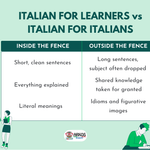
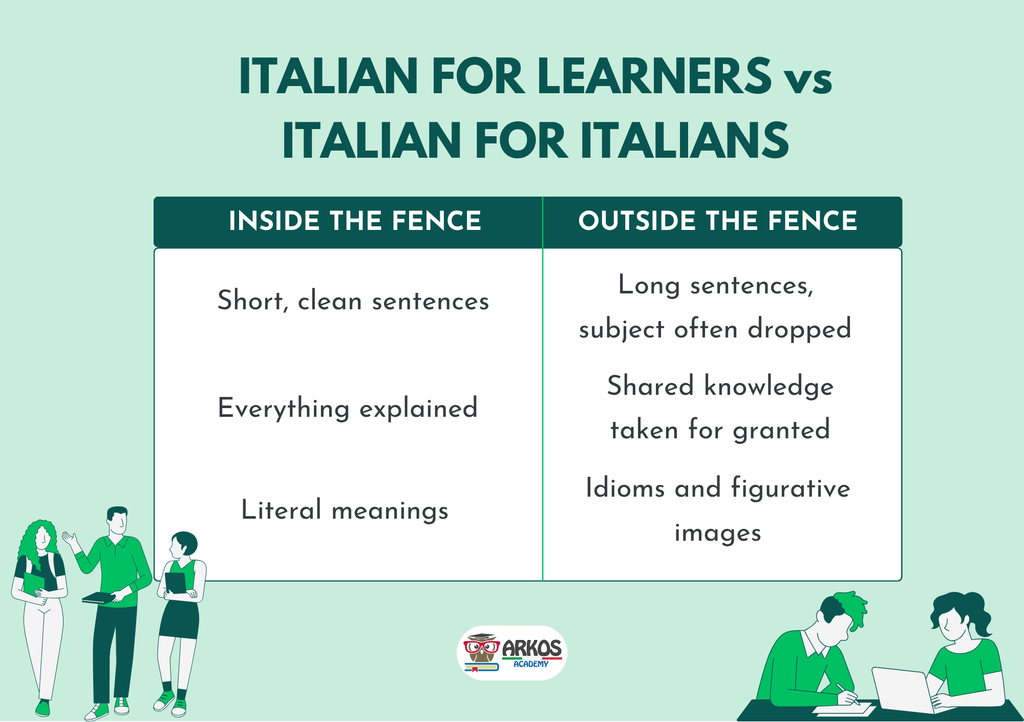
But this material works like a recinto, a fence around a field. Inside the fence you can walk safely and grow. And a fence has a second job that nobody mentions: it keeps things out. If no unfiltered Italian has reached you for months, the first real sentence feels like a wall.
So what you feel in that moment is usually not a gap in your Italian. It’s a gap in exposure. And you can’t close it with more of the same: another graded reader is useful, but it’s still inside the fence.
What changes when Italians write for Italians
When Italians write for each other, nobody is being careful. That’s not a problem: it’s simply what the language looks like in its natural state. Here are the main differences you’ll notice when you start to read Italian outside the classroom.
They assume you already know things
Native writers take a lot of shared knowledge for granted: places, TV shows, famous people, local habits, recent events. A single name or a short reference can carry a whole idea. You understand every word, but the meaning depends on something the text never explains.
Long sentences and missing pieces
Written Italian loves long sentences, with one clause inside another and the main verb far from the subject. At the same time, Italian is a language that often drops the subject: the verb ending tells you who is doing what, so ho capito doesn’t need io. In a long sentence, you have to keep track of who is speaking without any help.
Idioms and images
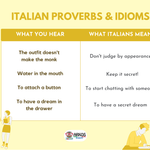
Italians use figurative language all the time, also in writing. A comment that says mi ha fatto cadere le braccia (literally “it made my arms fall”) is not about an accident: it means “I was so disappointed/baffled that I gave up”. If you translate word by word, you get a strange picture and miss the point. We explain why this happens in our guide to Italian idioms you can’t translate literally.
Abbreviations and spoken style online
In messages and comments, Italian can become fast and informal. You’ll see cmq (comunque, anyway), nn (non), xké (perché, because or why), x (per, for) and tvb (ti voglio bene, love you). Sentences are short, punctuation is creative, and the tone is close to spoken Italian.
Formal and bureaucratic Italian
At the other end, official letters, notices and forms use a register that even Italians find heavy. Si prega di… (please…), entro e non oltre (no later than), a decorrere da (starting from), and many impersonal sentences with si. It’s the same language, but dressed in a very stiff suit.
Not sure which texts are right for your level? Take our free Italian level test: it only takes a few minutes, and it tells you where you are today.
Where to start: the easiest authentic texts to read in Italian
The good news is that you don’t need to start with a novel. Authentic texts come in many sizes, and some of them are short, repetitive and full of clues. Here is a possible path, from easier to harder.
Signs and labels: the first real Italian you can read
Shop windows, train stations, product packages and instructions are a perfect first step. They are short, they repeat the same structures, and the context helps you a lot. Chiuso per ferie (closed for holidays), Vietato fumare (no smoking), Si prega di non toccare (please don’t touch): once you notice them, you’ll see them everywhere.
Menus and recipes
Food texts are real Italian, written for Italians, on a topic you probably already know. Recipes are full of useful verbs (tagliare, mescolare, soffriggere) and typical abbreviations, like q.b. (quanto basta, as much as needed). If you like the food world, our guide on how to order coffee in Italy is a nice companion.
Social media posts, comments and reviews
Posts and comments are short and very close to spoken Italian. Reviews of hotels, restaurants or products are even better, because you can often guess the general meaning (positive or negative) before you understand the details. Choose accounts about topics you love: travel, cooking, sport, gardening.
Blogs: read Italian about topics you already know
A blog written by Italians about one of your hobbies is a great bridge. You already know the topic, so your brain can focus on the language. This is the most important rule when you start to read Italian for real: choose content where the subject is familiar and only the language is new.
Short stories and contemporary books
When you feel ready for longer texts, try short stories or books written for Italian children and teenagers. They’re not simplified for foreigners, but the language is usually clearer and the stories move fast. Gianni Rodari and Italo Calvino’s Marcovaldo are classic choices for many intermediate learners. After that, choose a contemporary novel on a topic you enjoy: when the story keeps you curious, you’ll keep reading even when some words escape you.
How it feels to step outside the fence
Be ready for one thing: at the beginning, it will feel uncomfortable. You won’t understand everything, and that’s normal. Even in your own language, you don’t understand every word of every text: you simply don’t notice, because you know how to live with small gaps.
This is the real skill to train. Instead of stopping at every unknown word, try to read for the general meaning first. Who is writing? Is the tone positive or negative? What do they want? Many words become clear on their own a few lines later.
It also helps to stay with one type of text for a while. If you read ten recipes, the eleventh will feel much easier, because every genre repeats its own words and structures. Little by little, the wall becomes a door.
If you want a step-by-step method to make what you read stay in your memory, have a look at our guide to active reading in Italian.
Why it’s worth it to read Italian written for Italians
Your books are still useful, and you don’t need to throw them away. But at intermediate level, what’s missing is usually not one more rule or one more list of words. It’s contact with the language as it really is: fast, imperfect, full of references, and not adapted for anyone.
Every authentic text you read makes the next one a little easier. And one day, on a platform or in a café, you’ll open an Italian page and simply read it, without even noticing.
For free reading materials and resources for your level, visit our Free Library. And if you’d like help choosing the right texts and understanding what’s between the lines, take a look at our private lessons.