
How to use potere, volere, dovere and sapere with confidence
At some point in your Italian studies, you will need to express things like “I have to work”, “I can come” or “I want to go”. These are some of the most common structures in everyday Italian conversation, and they all pass through the same four verbs: potere, volere, dovere and sapere.
Just four verbs! Learn these well and you will be able to express obligation, possibility, desire and ability in almost any situation.
What are modal verbs in Italian?
Modal verbs, called verbi modali or even verbi servili in Italian, are a special group of verbs whose job is to “serve” another verb. They always appear together with a second verb in the infinitive form, and they add a layer of meaning to it: obligation, possibility, desire, or ability.
Italian has exactly four modal verbs:
| Verb | Core meaning |
|---|---|
| dovere | must, to have to |
| potere | can, to be able to |
| volere | to want to |
| sapere | to know how to |
You may have noticed that sapere is sometimes left out of lists of Italian modal verbs, even by well-known language learning resources. This is not quite correct: sapere is a full modal verb when followed by an infinitive, with its own specific meaning that cannot be replaced by potere. Let me explain this feature better.
A special case: sapere as a modal verb
Before looking at all four verbs in detail, it is worth stopping on sapere, because it is the verb that causes the most confusion, in lessons and in real life.
Sapere has two completely different functions in Italian:
1. Sapere = to know (a fact or piece of information)
In this case sapere is not a modal verb. It stands alone with a noun or a che clause:
- So il tuo numero di telefono. → I know your phone number.
- So che sei stanco. → I know that you are tired.
2. Sapere + infinitive = to know how to do something (a skill)
This is the modal use, and it expresses learned ability:
- Luisa sa cantare. → Luisa knows how to sing.
- Non so cucinare. → I do not know how to cook.
Above all for English speakers, the key distinction is between sapere and potere:
| Modal verb | Example | Meaning |
|---|---|---|
| Potere | Non posso cucinare, il forno è rotto. | I cannot cook, the oven is broken. (circumstance) |
| Sapere | Non so cucinare, sono un disastro. | I cannot cook, I am hopeless at it. (skill) |
Potere expresses possibility or permission. Sapere expresses knowing how to do something. They are never interchangeable in this context, and mixing them up is one of the most common mistakes I see in lessons.
Coming soon: a full article dedicated to sapere, its modal and non-modal uses, common mistakes, and how to use it correctly. Keep an eye on the Arkos Academy blog!
The four Italian modal verbs explained
Dovere — must, to have to
Dovere expresses obligation, necessity or duty.
Devo studiare stasera. I have to study tonight.
Dobbiamo andare all’aeroporto alle sei. We have to go to the airport at six.
One thing that many students find useful: dovere in the conditional (dovrei, dovresti, dovrebbe…) softens the obligation into advice or suggestion, similar to “should” in English.
- Devi chiamare tua madre. → You have to call your mother. (obligation)
- Dovresti chiamare tua madre. → You should call your mother. (advice)
Common uses of dovere:
- Obligation: Devi finire i compiti prima di uscire. → You have to finish your homework before going out.
- Necessity: Devo andare dal medico. → I need to go to the doctor.
- Advice (conditional): Dovresti dormire di più. → You should sleep more.
- Supposition: Dev’essere tardi. → It must be late.
Potere — can, to be able to, may
Potere is the most versatile of the four. It expresses possibility, permission or ability linked to a situation or circumstance, not to a learned skill.
Posso aprire la finestra? Can I open the window? (asking for permission)
Stasera non posso uscire, ho troppo lavoro. Tonight I cannot go out, I have too much work. (circumstance)
This is also the verb where students make the most errors, especially when confusing it with sapere. Keep that distinction in mind.
Common uses of potere:
- Permission: Puoi usare il mio computer. → You can use my computer.
- Possibility: Possiamo mangiare fuori stasera. → We can eat outside tonight.
- Polite request (conditional): Potresti aiutarmi? → Could you help me?
- Hypothesis: Potrebbe essere lui. → It could be him.
Watch out: As explained in the paragraph about sapere as modal verb, sentences like “Puoi suonare il pianoforte?” means “is it possible for you to play the piano?” not “do you know how to play?” For the second meaning, you need: Sai suonare il pianoforte?
Volere — to want to
Volere expresses desire or intention. It is the most straightforward of the four in terms of meaning, but there is one important detail that makes a big difference in real conversation.
Voglio imparare l’italiano. I want to learn Italian.
Saying voglio directly in Italian sounds quite strong, sometimes even a little rude. In formal situations or when ordering something, Italians almost always use the conditional vorrei (I would like) instead. This small change makes you sound much more natural:
- ❌ Voglio un caffè. → sounds very direct
- ✅ Vorrei un caffè, per favore. → polite and natural
Common uses of volere:
- Desire: Voglio visitare Roma. → I want to visit Rome.
- Polite request (conditional): Vorrei prenotare un tavolo. → I would like to book a table.
- Intention: Voglio smettere di fumare. → I intend to stop smoking.
Sapere — to know how to
As explained above, sapere as a modal verb expresses learned ability, something you have studied, trained for or practised over time.
So parlare italiano e francese. I know how to speak Italian and French.
Sai guidare? Do you know how to drive?
Non sa cucinare, ma sa fare ottimi dolci. He does not know how to cook, but he knows how to make excellent desserts.
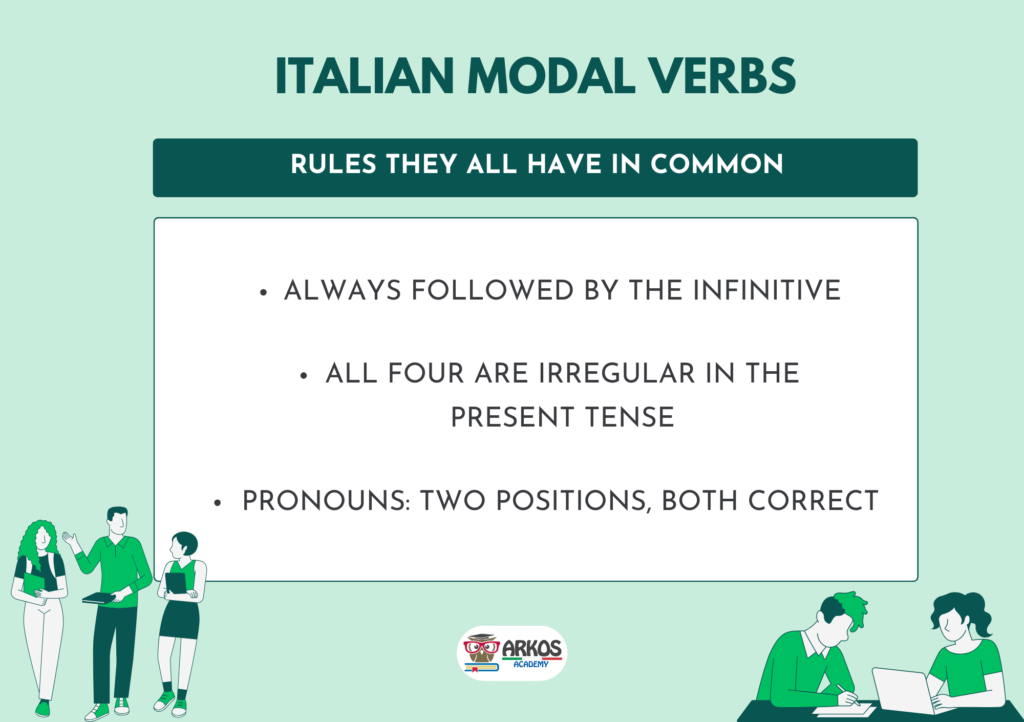
The rules that apply to all four modal verbs
1. Modal verbs are always followed by the infinitive
This is the most important rule: modal verb + infinitive verb. The second verb never changes. It always stays in the infinitive form.
Devo andare. → I have to go.
Posso venire. → I can come.
Voglio mangiare. → I want to eat.
So nuotare. → I know how to swim.
2. All four are irregular, especially in the present tense
Here is the full present tense conjugation:
| dovere | potere | volere | sapere | |
|---|---|---|---|---|
| io | devo | posso | voglio | so |
| tu | devi | puoi | vuoi | sai |
| lui/lei | deve | può | vuole | sa |
| noi | dobbiamo | possiamo | vogliamo | sappiamo |
| voi | dovete | potete | volete | sapete |
| loro | devono | possono | vogliono | sanno |
The irregularities do not stop here. They are also irregular in the future tense (dovrò, potrò, vorrò, saprò) and in the conditional (dovrei, potrei, vorrei, saprei). These are forms you will need very soon in your studies. .
3. Pronouns have two possible positions
When you use a pronoun with a modal verb, both options below are equally correct:
Option A — pronoun before the modal verb:
- Lo voglio fare. → I want to do it.
- Ti devo chiamare. → I have to call you.
Option B — pronoun attached to the infinitive (remove the final -e):
- Voglio farlo. → I want to do it.
- Devo chiamarti. → I have to call you.
In spoken Italian you will hear both forms constantly. Neither is more correct than the other.
Mini dialogue: all four modal verbs in action
Read the dialogue below and try to identify each modal verb. What does it express? Obligation, possibility, desire or ability?
Marco e Sofia stanno pianificando il weekend.
Marco: Ehi, Sofia, cosa vuoi fare sabato?
Sofia: Vorrei andare al mare, ma devo finire un progetto per lunedì.
Marco: Capisco. E domenica? Possiamo andare domenica!
Sofia: Sì, domenica posso! Sai guidare fino a là, vero?
Marco: Certo che so guidare! Ho la patente da dieci anni.
Sofia: Intendevo dire se conosci la strada! In ogni caso, secondo me dobbiamo prenotare un posto per pranzo, conosco un ottimo ristorante sul lungomare.
Marco: Ottima idea. Lo vuoi prenotare tu o lo prenoto io?
Sofia: Lo prenoto io, non ti preoccupare!
Let’s analyse it together:
- “cosa vuoi fare” → volere = desire
- “Vorrei andare” → volere conditional = polite wish
- “devo finire” → dovere = obligation
- “Possiamo andare” → potere = possibility
- “domenica posso” → potere = possibility linked to circumstance
- “Sai guidare” → sapere = learned skill
- “so guidare” → sapere = learned skill
- “dobbiamo prenotare” → dovere = necessity
- “Lo vuoi prenotare” → volere = desire/intention
Keep practising
Modal verbs are everywhere in Italian conversation. You cannot avoid them, and once you master these four, you will be able to express obligation, possibility, desire and ability in almost any context.
Want to know where you are with Italian grammar right now? Take the free Italian level test and get clear, immediate feedback. 👉 Take the free Italian level test
If you want to work on grammar in a structured way, with personalised feedback and lessons built around your level, take a look at the private lessons at Arkos Academy.