
The unwritten rules of formal and informal Italian
In English, one little word does all the work: “you”. You say it to your best friend, to your boss and to the King…
In Italian, every new conversation starts with a choice: tu or Lei? And that choice says a lot about how you see the person in front of you.
The grammar behind it is not difficult. What makes it tricky is everything around the grammar: who uses Lei with whom, who decides when to switch to tu, and what happens when you get it wrong. Textbooks give you clear rules, but Italian society keeps moving, and some situations are simply not in the books yet. In this guide we’ll look at how the polite form works, where it comes from, the situations where even Italians hesitate, and how to handle the switch from Lei to tu.
How tu and Lei work: the short grammar
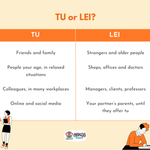
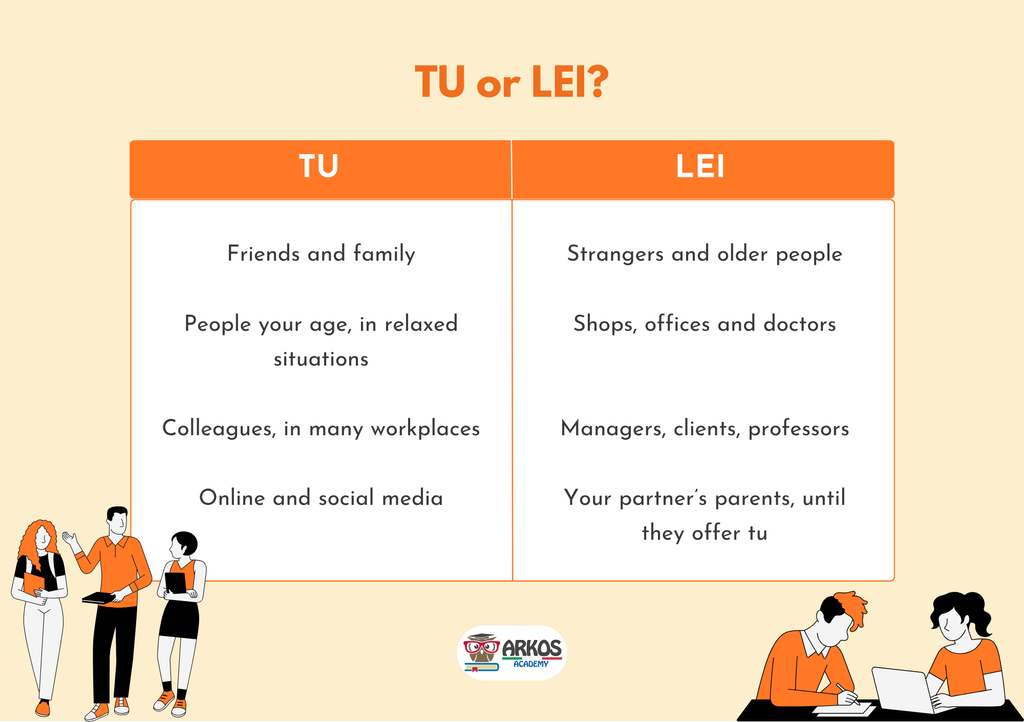
Tu is the informal “you”. You use it with friends, family, children, and with people your age in relaxed situations. The verb is in the second singular person: Tu sei di Roma? (Are you from Rome?)
Lei is the formal “you”. It looks exactly like lei (she), and it uses the same third-person verb: Lei è di Roma? In writing, it’s often spelled with a capital L. “Lei” works with men too. You can say Lei è molto gentile to a man, and it’s perfectly correct. With adjectives that change ending, Italians normally follow the real gender of the person: Signor Rossi, Lei è stanco? (Mr. Rossi, are you tired?)
The pronouns change too. You say ti ringrazio to a friend, but La ringrazio (thank you) to someone you address with Lei. As I told you before, you’ll often see Lei, La and Le written with a capital letter as a sign of respect. According to the Accademia della Crusca there is no strict rule that makes the capital letter compulsory, but in formal writing many people still use it.
Polite requests and the plural: beyond tu and Lei
Politeness in Italian is not only a pronoun. Formal requests often use the conditional, which makes them softer: Potrebbe aiutarmi? (Could you help me?), Vorrei un’informazione (I’d like some information). If you want to review the conditional forms behind these polite requests, our article on Italian modal verbs is a good place to start.
Then there’s the imperative. When you give an instruction or make a request to someone you address with Lei, Italian borrows the forms of the present subjunctive. So with a friend you say senti! (listen!), scusa (excuse me), vieni (come), but with Lei you say senta, scusi, venga. The idea is the same, a request or a polite command, but the tone becomes respectful. Pay attention to the pronouns too: with tu they attach to the end of the verb, with Lei they go before it. Siediti becomes si sieda (have a seat), and dimmi becomes mi dica (tell me), the phrase you’ll hear at almost every shop counter in Italy. And when someone welcomes you into an office, you’ll often hear si accomodi (please, come in and make yourself comfortable).
And when you speak to more than one person? Today Italians simply use voi, both formally and informally: Gradite un caffè? (Would you like a coffee?) The very formal Loro still exists, but you’ll hear it almost only in bureaucratic language or in very elegant hotels and restaurants.
A short history of tu, voi and Lei
Latin only had tu, as you can read in our article on the evolution of the Italian language. During the Middle Ages, voi became the respectful form for one person. Dante uses it in the Divine Comedy: he speaks to Beatrice with voi, and he switches to voi when he meets the soul of his noble ancestor in Paradise.
Lei arrived later, around the 16th century, in the courts of the Renaissance. It comes from long titles like Vostra Signoria (Your Lordship). These titles were feminine nouns, so the pronoun that referred to them was feminine too: ella, later lei. For about three centuries, tu, voi and Lei lived together in Italian, each with its own social meaning.
You may read that Lei was imported from Spain. This idea has been repeated since the 16th century, but linguists consider it unfounded: the form developed naturally inside Italian.
Here’s a surprise for English speakers: English once had the same choice. Thou was the informal “you”, while you was the polite form, originally used for more than one person, just like the Italian voi. Over the centuries the polite you won and thou disappeared. So, in a way, English speakers use the polite form with everyone, as Focus explains.
When Fascism tried to ban Lei
The strangest chapter in this story came in 1938. The Fascist regime decided that Lei was foreign, “effeminate” and servile, and that voi was more Roman and more virile. A newspaper campaign asked for its abolition, and the regime imposed voi in public life. A women’s magazine called Lei even had to change its name: it became Annabella. In 1939 there was also an anti-Lei exhibition, full of caricatures.
Not everyone obeyed. The philosopher Benedetto Croce, who had always used the Neapolitan voi, is said to have started using Lei as a form of protest. And in private, most Italians simply kept speaking as before. After the fall of Fascism, Lei came back everywhere.
What is left of voi today
The formal voi has not completely disappeared. You can still hear it in parts of Southern Italy, especially among older people, for example in a small shop or between an older customer and the owner. In the past, in many Southern families, children also used voi with their parents. In Sicily you may even hear vossia, a short form of vossignoria (Your Lordship). And in some areas of central Italy, such as parts of Abruzzo, people traditionally use tu with almost everyone.
Local languages and dialects have kept many of these old forms alive, as you can read in our article on Italian dialects. If you’re curious about how standard Italian changes from North to South, have a look at our guide to regional Italian variations.
Want to see where your Italian is right now? Take our free Italian level test: it only takes a few minutes.
When to use tu or Lei in real life
Rules are useful, but real situations are what matter. Here is how the choice between tu or Lei usually works in everyday Italy.
Shops, bars and restaurants
Staff normally use Lei with customers, and customers use Lei with staff, especially if they are older. In a bar, things are more relaxed: a young barista may use tu with young customers, and regular customers often use tu with “their” barista after a while. If you want to practice the bar situation, our guide on how to order coffee in Italy will help you.
Doctors, offices and public services
Here Lei is the norm, in both directions. At the post office, at the bank, with a doctor or a lawyer, you start with Lei and you usually stay there.
Older people and your partner’s parents
With older people you don’t know, Lei is a sign of respect. Your partner’s parents are a classic gray area. Many Italian families today are quite informal, and parents may soon ask you to use tu. But it’s safer to start with Lei and let them make the first move.
Work, colleagues and teachers
In many Italian offices, colleagues use tu with each other, even with people they’ve just met. With a manager, a client or an older colleague, start with Lei. From middle school on, children use Lei with their teachers, while teachers use tu with pupils. At university, students normally use Lei with professors, even if some young lecturers prefer tu.
Online and social media
Online, tu dominates. Many brands, apps and websites address their customers with tu to sound friendly and close. In comments and chats between strangers, tu is the normal choice. A formal email to an office, however, is a different story.
The gray areas: when even Italians hesitate between tu and Lei
Some situations are tricky for native speakers too. Think of the neighbor your age that you have greeted with Lei for years: now changing feels strange, but continuing feels too formal. Or a new colleague who is much older than you, but at your same level. Or the parents of a childhood friend, now that you are all adults.
In these moments, many Italians use a clever trick: they avoid the pronoun completely. They say Buongiorno! instead of Ciao, ask Come va? (How’s it going?) instead of Come stai? or Come sta?, and choose sentences without a direct “you” until the other person makes the choice for them. It’s a very Italian way to stay polite without committing.
Italians have many small tricks like this one, and some of them are hidden in their idioms, as you can see in our guide to Italian idioms you can’t translate literally.
How to switch from Lei to tu
The traditional rule is clear: the person with a higher position, or the older person, offers tu first. Modern etiquette usually puts rank before age. So a young manager can offer tu to an older employee, not the other way round.
The switch is often a small, friendly moment. You might hear:
Possiamo darci del tu? (Can we use tu with each other?)
Diamoci del tu! (Let’s use tu!)
Dammi pure del tu. (Feel free to use tu with me.)
The verb behind all this is dare del tu / dare del Lei (to address someone with tu or Lei), and darsi del tu when the choice is mutual. Once two people have switched to tu, going back to Lei sounds very cold, almost like a quarrel.
In general, the choice tends to be reciprocal: tu with tu, Lei with Lei. But here too, context decides. A doctor may use tu with an elderly patient as a sign of affection, especially after years of visits, while the patient keeps using Lei with the young doctor out of respect for the role. Nobody feels offended, because the relationship and the tone make the choice clear. An uneven use of tu and Lei becomes a problem only when it sounds like a lack of respect, not simply because the two pronouns are different.
The surprise: when Lei makes people feel old
Here’s something many learners don’t expect. Some Italians don’t like being addressed with Lei. It’s not that they find it rude: it makes them feel old.
Imagine a woman in her forties in a clothes shop. A young shop assistant says: Signora, Lei che taglia porta? (Madam, what size do you wear?) The answer might come with a smile and a little sigh: Ma dammi del tu, per carità! (Oh please, use tu with me!)
It happens more and more, because Italian society has become more informal and many people in their forties and fifties still feel young. So the “respectful” choice can sometimes sound distant. Don’t take it personally: if someone asks you to use tu, just switch, and enjoy the moment. It’s a small sign of friendship.
What happens if you mix up tu and Lei?
The good news: almost nothing. Nobody will correct you, and as a foreigner you have a natural “pass”.
What remains is a small impression. Use tu too soon, and you may sound a little too familiar. Insist on Lei with someone who has offered tu, and you may sound a little cold and distant. Even Italians sometimes mix tu and Lei in the same sentence, especially when they are unsure, and then laugh about it.
So, a few simple guidelines. When in doubt, start with Lei: it’s easier to move from Lei to tu than the opposite. Listen to how the other person speaks to you, and follow them. And when someone offers you tu, accept it.
Why the rules of tu and Lei are only the beginning
The rules about tu and Lei can be learned in an afternoon. The real skill is reading the situation: the age of the person, the place, the region, the relationship, the mood of the moment. And all this changes faster than textbooks do. Many situations that required Lei twenty years ago are completely informal today, and in twenty years things will probably be different again.
This is where a native teacher makes a difference. A teacher can explain why a certain choice sounds natural in Milan and less natural in Naples, or why your partner’s mother smiled when you used Lei, and show you situations that the books have not recorded yet. If you’d like to practice real conversations like these, take a look at our private lessons. For more free materials on everyday Italian, visit our Free Library, and for short video lessons on real spoken Italian, subscribe to our YouTube channel.