
The Words That Will Trick You Every Time
You have been studying Italian for a while. You know your verbs, you have memorised a good chunk of vocabulary, and you feel reasonably confident walking into a conversation. Then you say something that makes your Italian friend burst out laughing, or go completely silent with a puzzled look on their face.
Welcome to the world of Italian false friends. 😅
These are words that look or sound like English, but mean something entirely different in Italian. Because Italian and English both borrowed heavily from Latin, the two languages share thousands of words. Most of the time this works in your favour. Occasionally, it works against you, badly.
This article covers the most common Italian false friends, organised by just how much trouble they can get you into. I’m also sharing a link to download the guide with more than 70 of them.
What Are Italian False Friends?
False friends (also called “false cognates“), or falsi amici in Italian, are words that look similar across two languages but carry different meanings. They are not typos or mistakes, they’re perfectly real words in both languages that happen to have drifted apart over centuries of use.
The tricky part is that your brain sees a familiar shape and immediately files it under a meaning it already knows. You do not even notice you are making an assumption. That is exactly what makes these words so dangerous.
Level 1: Awkward but survivable
These false friends will cause confusion and maybe a polite correction, but nothing worse.
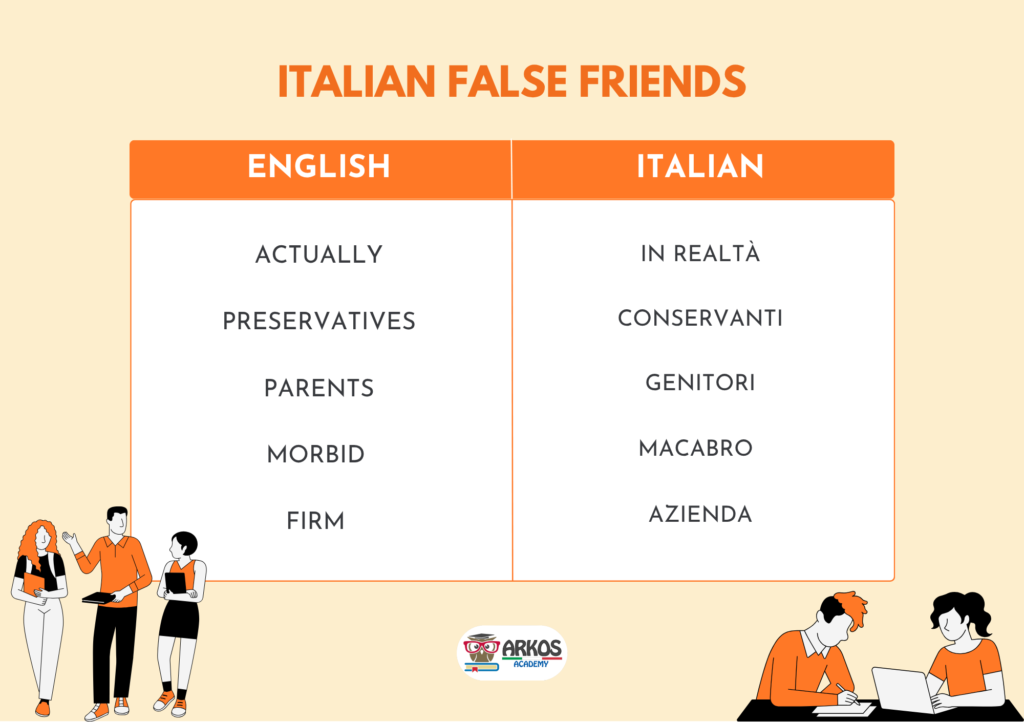
Attualmente does not mean “actually.” It means “currently”, or “at present”. If you want to say “actually,” use in realtà or veramente. So “attualmente vivo a Roma” means “I currently live in Rome,” not “I actually live in Rome.” A small difference in meaning, but enough to muddle what you are trying to say.
Morbido does not mean “morbid.” It means “soft”. The Italian word for morbid is morboso. So when an Italian tells you their new sofa is molto morbido, they are not sharing a dark obsession. They are just pleased with the upholstery.
Parenti does not mean “parents.” It means “relatives”. Your parents in Italian are i genitori. This one catches people out constantly: “I miei parenti vengono a cena” means “My relatives are coming to dinner,” not “My parents are coming to dinner.” Not a disaster, but just know you can have more than just two people at dinner!
Sensibile does not mean “sensible.” It means “sensitive”. A sensible person in Italian is una persona ragionevole or sensata. So saying “è una persona molto sensibile” describes someone who is emotionally sensitive, not someone with good judgment.
Educato does not mean “educated.” It means “polite”, “well-mannered”. An educated person is istruito or colto. If someone in Italy compliments you by saying “sei molto educato,” they are saying you have good manners, not a university degree.
Rumore does not mean “rumour.” It means “noise”. If you want to talk about a rumour or gossip, you need pettegolezzo or voce. “Ho sentito dei rumori” means “I heard some noises,” not “I heard some rumours.“
Level 2: These will cost you…!
These false friends can lead to genuine misunderstandings, awkward silences, or conversations that go completely off track.
Argomento does not mean “argument.” It means “topic” or “subject”. An argument in Italian, in the sense of a disagreement, is una discussione or un litigio. If an Italian colleague says “cambiamo argomento,” they want to change the subject, not drop the fight.
Pretendere does not mean “to pretend.” It means “to demand”, “to expect”, or “to insist” on something. To pretend in Italian is fingere. So “pretende troppo” does not mean “he pretends a lot” but rather “he expects too much.“
Deluso does not mean “deluded.” It means “disappointed”. Deluded in Italian is illuso. “Sono deluso” means “I am disappointed,” which is a very different emotional statement.
Fastidioso does not mean “fastidious.” It means “annoying”, “bothersome”. Fastidious in English carries a sense of being overly precise or particular. In Italian, fastidioso is closer to irritating.
Firma does not mean “firm” (as in a company). It means “signature”. An Italian company or firm is an azienda or società. So when someone asks for your firma, they want you to sign something, not hand over your business card.
Colloquio does not mean “colloquy.” It means “interview”, or a formal one-on-one conversation. If someone says “ho un colloquio domani,” they are nervous about a job interview, not a scholarly discussion.
Frequentare does not mean “to be frequent.” It means “to attend”, or to spend time with someone regularly. “Frequento un corso di italiano” means “I attend an Italian course.” The Italian word for frequent as an adjective is frequente.
Assumere does not mean “to assume.” It means “to hire”, or “to take in”. An employer who says “abbiamo assunto tre persone” has hired three people, not made three assumptions.
Level 3: The ones that can really embarrass you
These are the false friends with real consequences: they come up in everyday situations, they look completely innocent, and they can produce reactions you were not expecting.
Preservativo does not mean “preservative.” This is the most famous one, and for good reason. Preservativo means “condom”. The word for food preservative is conservante. Asking for food “senza preservativi” at a supermarket will produce a reaction you will not forget quickly. The correct phrase is senza conservanti.
Incidente does not mean “incident.” It means “accident”, often a serious one involving a vehicle or personal injury. What in English might be called a minor incident would typically be described in Italian as un episodio or un inconveniente. Using incidente for something trivial will alarm people unnecessarily.
Emozionato does not mean “emotional.” It means “excited”, or “moved” by something in a positive or anticipatory sense. Emotional in the broader English sense is emotivo. Saying “sono molto emozionato” before a trip or an event means you are excited, not that you are about to cry.
Mensa does not mean “menses.” It means “cafeteria”, or “a canteen”. The word has no connection to menstruation in Italian. A school or workplace mensa is simply where you eat lunch.
Libreria does not mean “library.” It means “bookshop”. A library is una biblioteca. Getting these two mixed up will send you to the wrong place every time.
Camera does not mean “camera.” It means specifically a bedroom. A photographic camera is una macchina fotografica or fotocamera. “Vado in camera mia” means “I am going to my room,” not “I am going to “get” my camera.“
Why does this happen?
Italian and English share Latin roots, which means many words have a common ancestor. Over centuries, the two languages evolved in different directions, and words that once meant the same thing gradually shifted in meaning. What you are left with are pairs of words that look like old friends but have gone their separate ways.
The good news is that once you learn a false friend, you tend to remember it: the slight surprise, the moment of correction, or the laugh it produces actually helps the real meaning stick.
The less good news is that… there are quite a few of them.
How many Italian false friends are there?
More than you might think. The examples in this article are some of the most common and most searched ones, but the list goes much further.
If you want to work through them properly, download the guide Don’t Trust Them, which covers more than 70 Italian-English false friends in a flashcard format. You can use it from start to finish for Italian to English, or flip it around for English to Italian. Each pair is presented cleanly so you can test yourself and build the habit of double-checking before you assume.
You can also watch the full playlist of false friends videos on the Arkos Academy YouTube channel, where each one is explained with examples and in context.
Before you go
This is very important: DO NOT let false friends make you afraid to speak.
Every learner gets caught out by them at some point. Italians are generally understanding, and these moments of confusion often turn into useful, memorable conversations. The goal is awareness, not perfection.
Once you know the traps, you can navigate around them. And when you stumble into one, at least now you will know why.
If you are not sure where your Italian level is right now, the free level test is a quick way to find out.