
Ora, tempo and volta explained
In this guide, we will explain how to say time in Italian and when to use ora, tempo and volta correctly.
One of the first things students notice when they start learning Italian is that some very simple English words have multiple translations. “Time” is a perfect example. In Italian, depending on the context, you might need ora, tempo or volta, and they are not interchangeable.
If you have ever said “che tempo è?” when you wanted to ask what time it was, this article is for you. (Spoiler: that sentence actually means “what’s the weather like?”!)
Let’s look at each word one by one.
How to say time in Italian: the three main words
Depending on the context, time in Italian is translated as ora, tempo or volta. Here is how each one works.
Ora : clock time and specific moments
Knowing how to say time in Italian starts here: ora is the word you will use most often in everyday situations.
Ora is the word to use when you are talking about a specific point in time, like the time on a clock.
Che ora è? — What time is it?
Che ore sono? — What time is it? (also very common in spoken Italian, interchangeable with the previous one.)
A che ora ci vediamo? — What time are we meeting?
Ora is also used in the expression è ora di… (it’s time to…), which refers to a specific moment when something should happen:
È ora di andare, è già tardi. — It’s time to go, it’s already late.
È ora di smettere. — It’s time to stop.
One more thing worth knowing: ora also means now, as a synonym for adesso:
Lo faccio ora. — I’ll do it now.
Ora non posso, sono occupata. — I can’t right now, I’m busy.
Tempo — duration, abstract time and more
Tempo is the most versatile of the three. It covers several meanings, so let’s go through them one by one.
1. Time as a general concept or duration
This is the most common use. When you talk about time in an abstract sense, or about how long something takes, use tempo:
Il tempo vola quando ci si diverte. — Time flies when you are having fun.
Hai tempo per un caffè? — Do you have time for a coffee?
Non ho avuto tempo di chiamarti. — I did not have time to call you.
Ci metti sempre tantissimo tempo per truccarti! — You always take so long to do your makeup!
Non preoccuparti, il tempo cura ogni ferita. — Do not worry, time heals everything.
2. Time as a historical period
Ai tempi dei miei nonni, i bambini aiutavano nei campi. — In my grandparents’ time, children helped in the fields.
Un tempo le cose erano molto diverse. — Once, things were very different.
3. Weather
Yes, tempo also means weather! This is one of the most common points of confusion for English speakers:
Che tempo fa? — What is the weather like?
Che brutto tempo! Grandina e c’è un vento fortissimo! — What terrible weather! It’s hailing and there’s a very strong wind!
4. Grammatical tense
If you have ever had an Italian lesson, you have already heard this use of tempo: we use it to refer to verb tenses:
Il tempo presente, il tempo passato, il futuro… — The present tense, the past tense, the future…
5. Musical “tempo”
Tempo is also used in music to indicate rhythm and speed.
Beatrice si muoveva a tempo di musica. — Beatrice was moving to the rhythm of the music.
Volta — repetition and occasions
Volta (plural: volte) is the word to use when you talk about how many times something happens, or when you refer to a specific occasion.
1. Repetition
Quante volte alla settimana vai in palestra? — How many times a week do you go to the gym?
Ogni volta che ti parlo, mi ignori! — Every time I talk to you, you ignore me!
Ci sono stato cinque volte. — I have been there five times.
Qualche volta andiamo al cinema insieme. — Sometimes we go to the cinema together.
2. A specific occasion in the past
Ricordo che una volta siamo andati in quel ristorante e abbiamo mangiato malissimo. — I remember that once we went to that restaurant and the food was terrible.
Volta is also the word behind one of the most famous Italian expressions in the world:
C’era una volta… — Once upon a time…
Other ways to say time in Italian: “momento” and “orario”
While ora, tempo and volta cover most situations, there are two other Italian words that can translate “time” in more specific contexts.
Momento is used when you refer to a precise instant or a particular point in time — closer to “moment” in English:
Questo non è un buon momento. — This is not a good time.
Dov’era lui in quel momento? — Where was he at that time?
Aspetta un momento! — Wait a moment!
Orario refers to a schedule or timetable — a fixed, organised time:
L’orario dei treni — the train timetable
Qual è il tuo orario di lavoro? — What are your working hours?
Il negozio ha orari ridotti d’estate. — The shop has reduced hours in summer.
These two words have a more specific meaning than ora, tempo and volta, so they are less likely to cause confusion, but… they’re good to know!
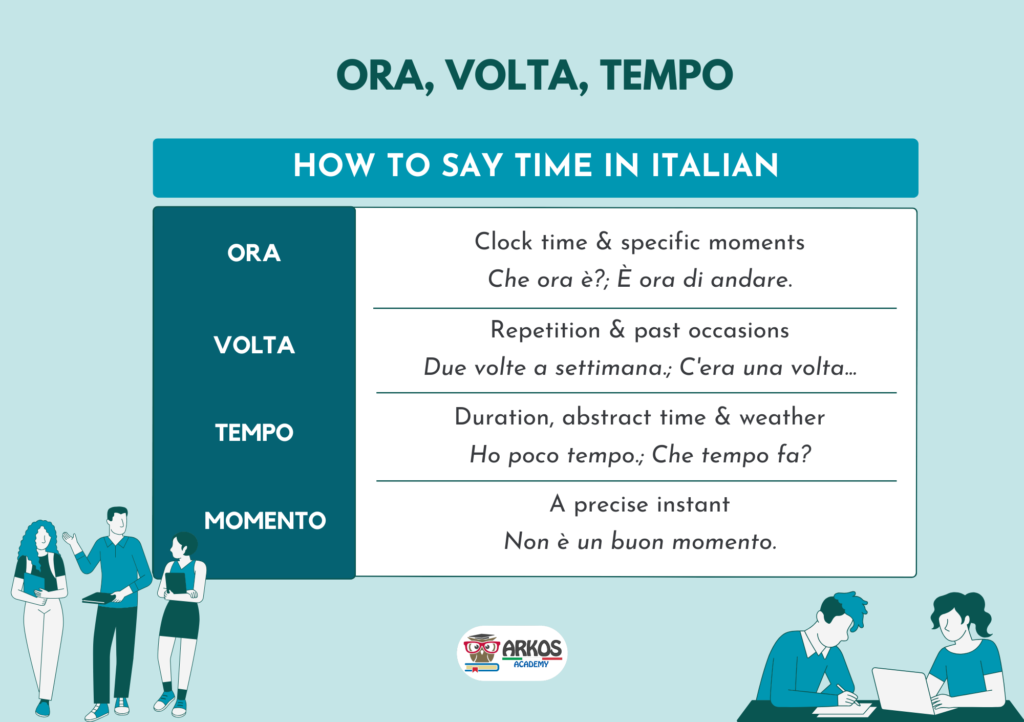
How to say time in Italian: a quick summary
| English “time” | Italian word | When to use it |
|---|---|---|
| Clock time | ora | Che ora è? |
| Duration / abstract time | tempo | Ho poco tempo. |
| Weather | tempo | Che tempo fa? |
| Grammatical tense | tempo | Il tempo presente |
| Number of times | volta/volte | Due volte a settimana |
| A past occasion | volta | Una volta siamo andati… |
| A specific instant | momento | In quel momento… |
| A schedule | orario | L’orario dei treni |
Watch the full lesson
If you want to hear these words explained in context with more examples, watch the video lesson on my YouTube channel:
👉 Ora, Tempo and Volta — watch the full lesson
Mini dialogue: ora, tempo and volta in action
Read the dialogue and try to identify every use of ora, tempo and volta. What does each one mean in context?
Sara e Giulio stanno organizzando il fine settimana.
Sara: Ciao Giulio, sai dirmi che ora è?
Giulio: Sono le undici. Perché?
Sara: È ora di uscire! Ci aspettano alle dodici.
Giulio: Un momento, non ho ancora finito. Ho bisogno di ancora un po’ di tempo.
Sara: Ogni volta è la stessa storia con te!
Giulio: Non è vero! L’ultima volta sono stato prontissimo, ricordi?
Sara: Sì, ma quella volta eravamo già in ritardo di venti minuti.
Giulio: Ok ok, arrivo. Che tempo fa fuori?
Sara: Bellissimo! Nessuna scusa, dai!
Let’s analyse it:
- “che ora è” → ora = clock time
- “è ora di uscire” → ora = it’s time to…
- “un momento” → momento = a specific instant
- “un po’ di tempo” → tempo = duration
- “ogni volta” → volta = repetition
- “l’ultima volta” → volta = a specific past occasion
- “quella volta” → volta = a specific past occasion
- “che tempo fa” → tempo = weather
Keep practising
Ora, tempo and volta are three of the most common words in everyday Italian. The good news is that the more you listen and read in Italian, the more natural the right choice will feel!
Want to find out your current Italian level and what to focus on next? Take the free Italian level test — it only takes a few minutes and gives you clear, immediate results.
👉 Take the free Italian level test