
Why they matter more than you think
If you’ve ever said “capello” when you meant “cappello”, you’ve already experienced the power of Italian double consonants — and you probably didn’t even know it.
The truth is, Italian pronunciation isn’t just about getting the sounds right. It’s about understanding three features that work together to give Italian its unmistakable musicality: double consonants, pure vowels, and natural rhythm. Miss one of them, and something feels off. Master all three, and you’ll start sounding like you actually live in Italy.
Let’s break them down one by one.
Why Italian pronunciation feels different from English
Before diving in, it’s worth understanding one fundamental difference between Italian and English: Italian is a syllable-timed language.
In English, stressed syllables are longer and louder, while unstressed ones get squashed and reduced. Think of the word “about” — that first syllable almost disappears. Italian works completely differently: every syllable gets roughly the same amount of time, like steady beats on a drum.
This is why Italian sounds so even, clear and musical to English ears. And it’s also why English speakers (and I notice this in my students’ efforts), used to reducing unstressed syllables, often sound a little “off” when speaking Italian — even when every single word is correct.
Italian double consonants (le doppie): small detail, big difference
Double consonants — called le doppie in Italian — are one of the most distinctive features of the language, and one of the trickiest for English speakers to master.
In English, double consonants rarely change the way a word sounds. In Italian, they change everything — including the meaning.
Why double consonants matter
Look at these pairs:
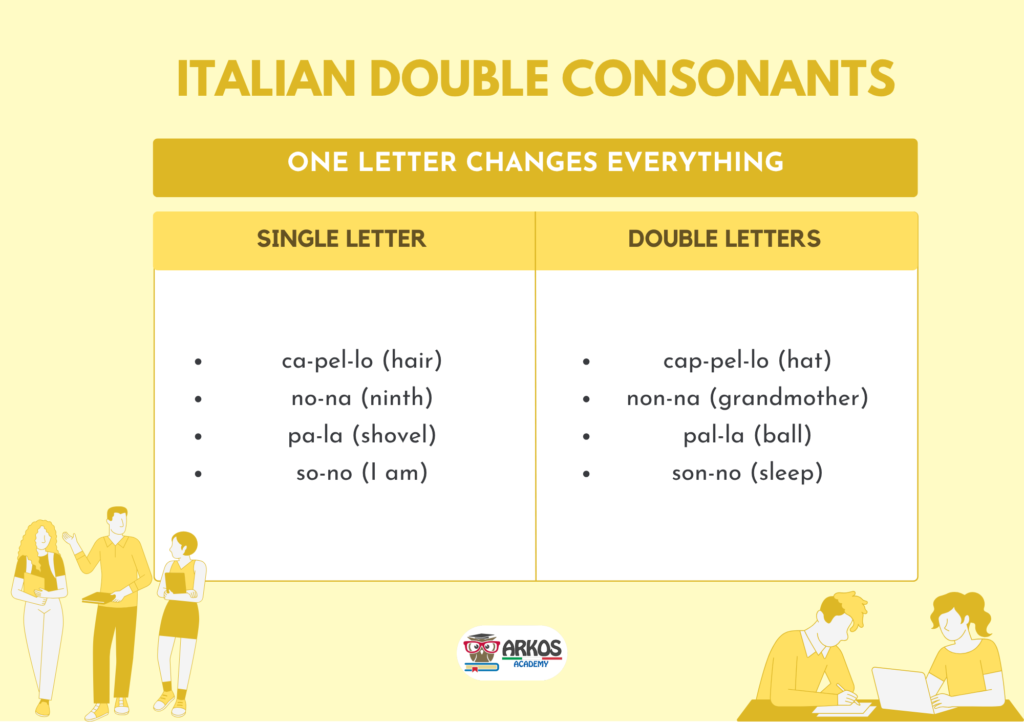
Getting these wrong doesn’t just sound foreign — it can genuinely confuse a native speaker, or worse, cause an embarrassing misunderstanding!
Let’s do a quick exercise: write the difference between the words in the pairs and try to practice your pronunciation by looking in the dictionary.
How to pronounce them
The key is length, not force. When you see a double consonant, don’t just hit it harder — hold it slightly longer. Think of it as a small pause or a brief moment of suspension before releasing the sound.
For example:
- palla → don’t say “PA-la”, say “PAL-la” — hold the L a beat longer
- nonna → “NON-na” — linger on the N before moving to the next syllable
- cappello → “cap-PEL-lo” — feel the double P as a tiny stop before releasing
A useful mental image: imagine bouncing on the double consonant as you say the word. That small bounce is exactly the length you need.
Good news (maybe? 😅): all consonants in Italian can be doubled except H (which is always silent). And doubled consonants always appear in the middle of a word — never at the beginning or end.
If you want to practise your ear for these sounds, our free library includes resources to help you train your listening and get comfortable with the doppie in context: our Pronunciation flashcards are in the library, ready for you to be used!
Italian vowels: pure, clear and consistent
Italian has 5 vowels — A, E, I, O, U — but 7 distinct vowel sounds, because both E and O have two possible pronunciations: an open and a closed one. And unlike English vowels, which shift and blur depending on stress, Italian vowels are pure and consistent: each sound is always produced the same way, clearly and fully.
Here’s a quick reference:
| Letter | Sound | Example |
|---|---|---|
| A | ah (as in “father”) | pasta |
| E (closed) | eh (as in “bed”) | bene |
| E (open) | è — more open, like “there” | è, caffè |
| I | ee (as in “see”) | vino |
| O (closed) | oh (as in “more”) | solo |
| O (open) | ò — more open, like “off” | cosa, uomo |
| U | oo (as in “food”) | uno |
The biggest mistake English speakers make with vowels
The most common error is reducing unstressed vowels to a schwa — that lazy “uh” sound that English uses constantly. In Italian, this simply doesn’t exist.
Telefono is not “TEL-uh-fohn” — it’s “te-LE-fo-no”, with every vowel clear and distinct.
The same goes for words like italiano, capire, bellissimo — every single syllable deserves its full vowel sound. This is what gives Italian its characteristic clarity and openness.
Tip: When in doubt, open your mouth more than you think you need to. Italian vowels are produced with more jaw movement and less tension than English ones. My students always laugh when I do silly faces to let them understand, but this actually works! 😆
Italian rhythm and stress: the music behind the words
Now that you’ve got the vowels and consonants in place, it’s time to talk about the bigger picture: rhythm and stress.
Where does the stress fall?
Italian words are classified into four main types based on where the stress falls:
| Type | Stress on | Example |
|---|---|---|
| Piana (most common) | second-to-last syllable | CA-sa, par-LA-re |
| Sdrucciola (very common) | third-to-last syllable | te-LE-fo-no, SU-bi-to |
| Tronca | last syllable | caf-FÈ, cit-TÀ, per-CHÉ |
| Bisdrucciola (rare) | fourth-to-last syllable | DI-te-me-lo, A-bi-ta-no |
The vast majority of Italian words are either piane or sdrucciole — so if you’re unsure how to stress a new word, defaulting to the second-to-last syllable will be correct most of the time.
Written accent marks are only used on parole tronche — words stressed on the last syllable. The accent is almost always grave (`) except on a small set of grammatical words where it is acute (´), such as perché, poiché, affinché. Single-syllable words like di, su, me, no are not written with an accent even though they are technically tronche.
For English speakers, the main trap is applying English stress patterns to Italian words — stressing the first syllable by default, or reducing unstressed syllables. Both habits immediately disrupt the natural flow of Italian speech.
The rhythm of Italian sentences
Beyond individual words, Italian sentences have their own rhythm — and it’s remarkably even compared to English. Linguists classify Italian as a syllable-timed language, meaning that each syllable tends to receive roughly equal duration, while English is stress-timed — stressed syllables are longer and louder, and unstressed ones get compressed or reduced.
Compare:
- English: “I’d LIKE a CUP of COFfee” (stress-timed, uneven)
- Italian: “Vor-rei-un-caf-fè” (syllable-timed, more even)
That said, this distinction isn’t absolute. Regional accents and dialects introduce significant variation in rhythm and intonation across Italy — a Roman speaker and a Milanese speaker will sound quite different to a trained ear. What remains consistent, however, is the clarity of vowels and the absence of the vowel reduction that makes English sound so compressed. And it’s precisely this combination — syllabic evenness, pure vowels, expressive intonation and the rhythmic punch of double consonants — that gives Italian its characteristic musicality. It’s not just perception: it’s linguistics.
Intonation: the melody of Italian
Closely linked to rhythm is intonation — the rise and fall of pitch across a sentence. Italian intonation is expressive and melodic, and while regional variation plays a significant role here too, some general patterns are consistent across most varieties of standard Italian:
- Statements generally end on a falling tone
- Yes/no questions typically rise at the end
- Wh- questions (who, what, where…) tend to fall, similarly to statements
The best way to absorb Italian intonation naturally is through active listening to native speakers — not just one regional variety, but several. A Neapolitan and a Milanese will sound quite different, and both are equally Italian. Our article on listening in Italian can help you build that ear systematically.
Putting it all together: a quick pronunciation workout
Here’s a simple daily routine to practise all three elements at once:
- Double consonants (5 minutes): say these pairs slowly, then faster, focusing on the length difference: pala / palla — sete / sette — nona / nonna — caro / carro
- Vowel clarity (5 minutes): read these words aloud, making sure every vowel is open and distinct: bellissimo — italiano — capire — telefono — università
- Rhythm and stress (5 minutes): read a short Italian sentence aloud, tapping your finger for each syllable to keep the beats even. Try: “Buongiorno! Vorrei un caffè e un cornetto, per favore.”
Even just 15 minutes a day, done consistently, will make a noticeable difference in how natural your Italian sounds.
Ready to take your pronunciation further?
If you’d like to go deeper on any of these topics, our Italian Alphabet and Pronunciation video course covers everything step by step — from individual sounds to connected speech — with video lessons, audio examples and personalised guidance.
And if you’re not sure yet which level of support you need, start with the free Italian level test — you’ll get instant feedback on where you are and what to focus on next.