
When to use simple prepositions vs combined forms
Learning how to use Italian prepositions is one of the biggest challenges for English speakers studying Italian: Italian prepositions are one of the most challenging areas of Italian grammar for foreign learners. A very common question among my students during our 1-on-1 lessons is:
When do I use an Italian preposition on its own, and when do I need to combine it with an article?
This article focuses on that exact question. Instead of covering every possible use of Italian prepositions, we will concentrate on the core distinction between simple prepositions and combined (articulated) prepositions.
From this point on, after introducing the terms in English, we will also use the Italian grammatical labels preposizioni semplici and preposizioni articolate. These are the terms you will encounter in Italian grammar books and lessons, and using them will help you connect explanations in English with real Italian usage.
What are Italian prepositions?
Italian prepositions are small words that connect other words in a sentence and express relationships such as place, movement, origin, possession, or topic.
In this guide, you’ll learn how to use Italian prepositions correctly, focusing on the difference between simple and articulated forms.
Italian has nine simple prepositions:
- di (of, from, about)
- a (to, at)
- da (from, by, at someone’s place)
- in (in, into, by)
- con (with)
- su (on, about)
- per (for, through)
- tra / fra (between, among)
However, not all of them behave in the same way. All Italian prepositions can be followed by a definite article, but only some of them fuse with it into a single word. Understanding the difference between combining with an article and fusing with it is essential.
Simple prepositions vs combined forms: the key idea
Before looking at which prepositions fuse with articles and which do not, it is important to clarify what a preposizione articolata actually is.
What is an articulated (combined) preposition?
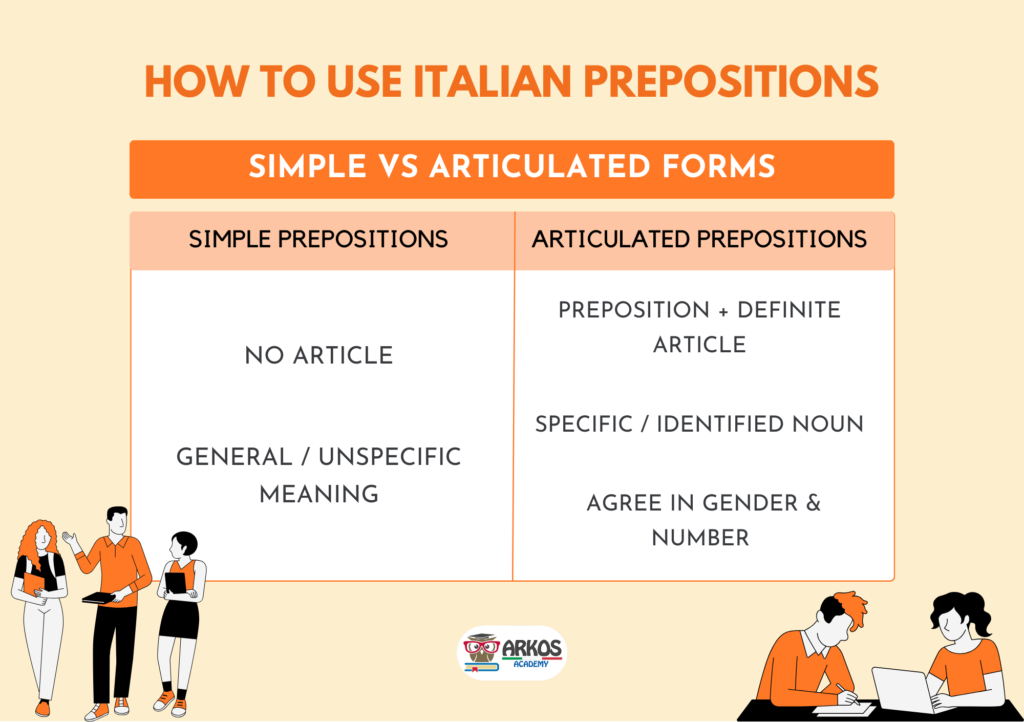
An articulated preposition is a preposition followed by a definite article that agrees in gender and number with the noun it refers to.
This agreement is not optional: the article must always match the noun.
For example:
- il libro di + il professore → del professore
- la casa vicino a + la stazione → alla stazione
- i ragazzi sono da + i* nonni → dai nonni*
In all these cases, the article (il, la, i) agrees with the noun (professore, stazione, nonni).
Combine vs fuse: the key distinction
The main confusion for learners comes from this question:
Do I need to add an article after the preposition, and if so, does it fuse with the preposition or stay separate?
All Italian prepositions can be followed by a definite article. However, only some prepositions fuse with the article into a single word.
How to use Italian prepositions with articles
Prepositions that fuse with the article
Only five prepositions fuse with definite articles:
- di
- a
- da
- in
- su
When these prepositions are followed by a noun that requires a definite article, the preposition and article fuse into one word (for example: di + il → del, a + lo → allo).
Prepositions that do not fuse with the article
The other prepositions do not fuse, even though they can still be followed by an article:
- con → con il libro, con la macchina
- per → per il lavoro, per la strada
- tra / fra → tra i palazzi, fra le persone
In these cases, the article remains visible and separate.
All of these forms are extremely frequent in everyday Italian and cannot be avoided.
Preposizioni semplici vs articolate
Now that we have seen how preposizioni articolate are formed, it is time to answer the most practical question for learners: when should you use a simple preposition instead of its combined form?
Italian prepositions combine with articles when the noun that follows normally takes a definite article.
Compare:
- *vado *a scuola (no article → no combination)
- *vado *alla scuola di Paolo (specific school → article → combined form)
Another example:
- *parliamo *di politica (general topic, no article)
- *parliamo *della politica italiana (specific topic → combined form)
The presence or absence of the article changes the meaning and determines whether the combined form is required. In general, preposizioni semplici tend to express a more general or generic meaning, while preposizioni articolate introduce a noun that is specified, identified, or expanded by an adjective, a modifier, or a defining phrase.
Di più, in più, or just plain più? When should you use these options? Click here to find it out
.Important: when articulated prepositions are not used
There are also clear situations in which Italian uses only preposizioni semplici, even though a noun or pronoun follows. In all of these cases, the article is absent, so articulated prepositions are not possible.
- Before demonstrative adjectives and pronouns (questo, quello, etc.):
- Il costo di questo hotel è veramente esagerato.
- Parliamo con quella ragazza.
- Before personal pronouns (me, te, lui, lei, noi, voi, loro):
- Posso venire da voi a trovarvi?
- Parlo sempre con lei.
- Before indefinite adjectives and pronouns (qualche, ogni, alcuni, tutti, etc.):
- Solo in qualche bar puoi trovare quel cocktail.
- Ho visto su ogni sedia un libro.
- Parlo con alcuni studenti.
- Before the relative pronouncui:
- Quello è l’amico a cui ho parlato della nostra situazione.
- La persona di cui ti parlavo è arrivata.
- Before indefinite articles:
- *Andiamo **da un’*amica.
- Ho letto di un libro interessante.
- Before proper names of people, places, …:
- Ho parlato con Anna ieri.
- Vado da Marco questo pomeriggio.
- Before possessive adjectives followed by a singular family member:
- Non toccarlo, è di mia sorella.
- Vado da tuo fratello.
- Exception: with loro or when the family noun is modified (for example with a diminutive), the article is used:
- della loro madre
- *al mio *fratellino
Why this is difficult for English speakers
English does have multi-word prepositions and fixed prepositional expressions (for example in front of, because of, out of), so the idea of a preposition made of more than one word is not unfamiliar.
The key difference is that English uses articles much less systematically than Italian. In Italian, nouns are very often introduced by a definite article, and this directly affects the form of the preposition that comes before them.
As a result, English speakers often:
- forget to use the article in Italian when it is required, or
- translate word-for-word from English without considering whether Italian needs an article.
In Italian, however, when a definite article is required, the preposition must combine with it — and, in some cases, fuse into a single word. Using a il instead of al or di il instead of del immediately sounds unnatural.
Key takeaways: when to use simple vs articulated prepositions
- Use preposizioni semplici when no definite article is required (general meaning, unspecific reference, pronouns, proper names, indefinite articles).
- Use preposizioni articolate when the noun requires a definite article and the preposition is di, a, da, in, su.
- The article of the *preposizioni articolate *must always agree in gender and number with the noun it refers to.
- Some prepositions (con, per, tra/fra) can be followed by an article but never fuse with it.
- In many cases, the difference between simple and articulated forms reflects the difference between general vs specific meaning.
Keeping these principles in mind will help you choose the correct form more naturally and avoid the most common mistakes.
Watch the video explanation
If you prefer to deepen this topic, check this video out:
What comes next?
This article is the first step in understanding Italian prepositions. In future articles, we will focus on:
- Italian prepositions with verbs
- Italian prepositions with nouns
- Individual uses of di, a, da, in, su
For now, the most important takeaway is this:
If the noun needs a definite article, and the preposition is di, a, da, in, or su, you must use the combined form.
Final thoughts
Mastering Italian prepositions takes time, but understanding the difference between simple and combined forms gives you a strong foundation. Once this distinction is clear, many other grammatical choices will start to make sense naturally.
If you want to continue improving your Italian with structured materials, you can explore the resources available in the Arkos Academy Free Library.