
When to use each tense in Italian
Understanding passato prossimo vs imperfetto is one of the biggest challenges for English speakers studying Italian. While both tenses refer to the past, they are not interchangeable: choosing the wrong one can completely change the meaning of a sentence.
This article explains the difference between passato prossimo and imperfetto in a clear and practical way, focusing on how Italian speakers actually choose between these two past tenses. Instead of memorizing long lists of rules, you will learn how to recognize the logic behind each tense and apply it naturally.
The core idea: completed events vs background
To understand this contrast, it helps to stop thinking only in terms of when something happened and start thinking about how the speaker presents the event.
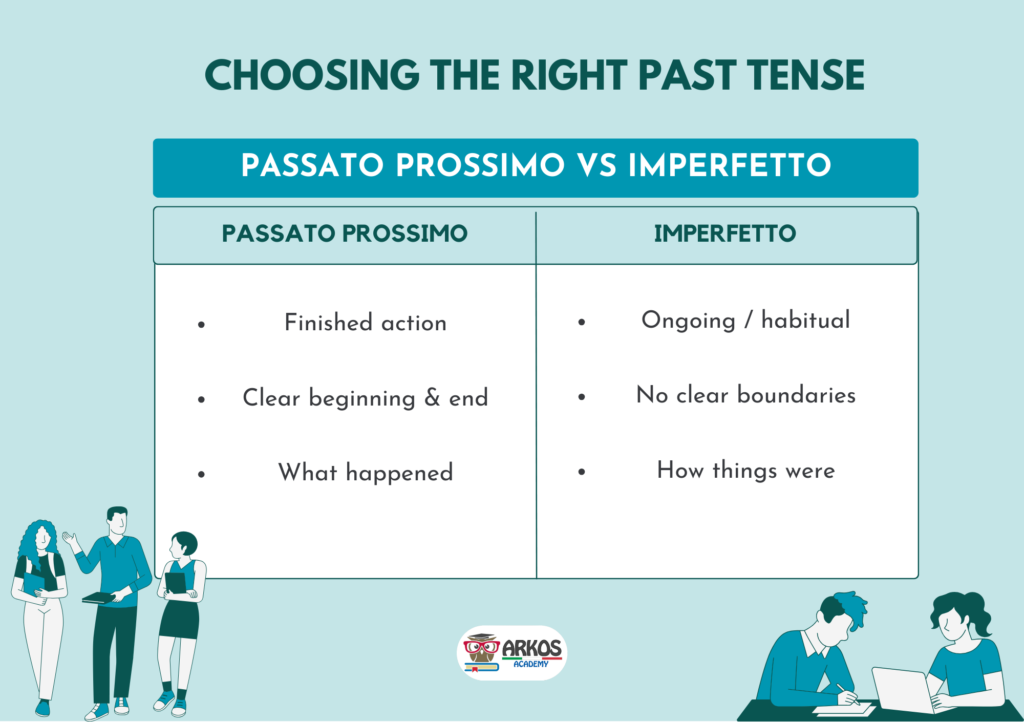
- Passato prossimo presents an action as completed, finished, or viewed as a whole.
- Imperfetto presents an action as ongoing, habitual, or descriptive, without focusing on its beginning or end.
A simple way to visualize this difference is:
- Passato prossimo = a snapshot (a finished event)
- Imperfetto = a background scene (how things were)
This way of organizing past events is deeply connected to how Italian has evolved as a narrative language over time.
If you’re curious about this broader perspective, you may also enjoy reading my article on the evolution of the Italian language, where I explain how Italian structure and usage have changed across centuries.
Choosing the right Italian past tense
This article focuses on usage, but a short reminder can be helpful.
- Passato prossimo is a compound tense: avere / essere + past participle.
- Ho mangiato, sono andata, abbiamo visto
- Imperfetto is a simple tense with very regular endings:
- -vo, -vi, -va, -vamo, -vate, -vano
- parlavo, credevi, dormivano
Form is important, but meaning is what really matters when choosing between the two Italian past tenses.
When to use the passato prossimo
Use the passato prossimo when you want to talk about:
- Completed actions in the past
- Ho finito il lavoro.
- Single events that happened once
- Ieri ho incontrato Maria.
- A sequence of events
- Mi sono svegliato, ho fatto colazione e sono uscito.
- Actions in a clearly defined time frame
- Ho vissuto a Roma per due anni.
In all these cases, the action is presented as closed and finished — a key idea behind the choice of tense in Italian.
For a formal grammatical definition of the passato prossimo and its aspectual value, see the Treccani entry in the Enciclopedia dell’Italiano.
When to use the imperfetto
Use the imperfetto when you want to describe:
- Habits and repeated actions in the past
- Da bambino andavo al mare ogni estate.
- Descriptions of people, places, weather, or emotions
- La casa era piccola e faceva freddo.
- Ongoing actions in the past
- Alle cinque pioveva.
- Two actions happening at the same time
- Io studiavo mentre lei lavorava.
The imperfetto does not answer what happened, but rather how things were, providing background rather than events.
A detailed linguistic description of the imperfetto, including its narrative and descriptive functions, is available in the Treccani Enciclopedia dell’Italiano.
The most common pattern: interruption
One of the most frequent structures combining the two Italian past tenses is the interruption pattern.
- Imperfetto → background action
- Passato prossimo → interrupting event
Example:
- Mentre guardavo la TV, ha suonato il telefono.
The background action (guardavo) was already in progress when the completed event (ha suonato) happened.
Common traps for English speakers
“Ero” vs “sono stato”
English often uses I was for many different meanings. In Italian, the choice between ero and sono stato depends on whether you are describing a state or a completed experience.
- Ieri ero stanco. (description of a state)
- Sono stato a Milano per tre giorni. (completed stay)
Modal verbs: intention vs result
With verbs like dovere, potere, and volere, the tense can change the meaning in a subtle but important way — a distinction well documented in Italian descriptive grammar.
- Volevo studiare → intention or desire (the result is uncertain)
- Ho voluto studiare → decision and concrete outcome
These meaning shifts show why choosing the correct past tense in Italian always depends on context, not translation. For a more in-depth linguistic explanation of aspect and tense usage in Italian, see the reference entries provided by Treccani.
Mini reading: how Italian mixes background and events
Read the short text below and focus on why Italian uses one tense rather than the other.
Ieri sera pioveva forte. Stavo guardando un film quando improvvisamente il telefono ha squillato. Ho risposto subito, ma nessuno parlava.
In this short paragraph:
- pioveva and stavo guardando describe the background situation.
- ha squillato and ho risposto introduce specific, completed events.
This type of contrast is extremely common in Italian storytelling and is one of the clearest ways to understand how the two past tenses work together.
Not sure about your level?
If you find the difference between passato prossimo vs imperfetto clear in theory but still difficult in practice, that is completely normal. This topic usually sits between upper-beginner and intermediate Italian, and many learners misjudge their actual level.
Not sure whether this topic matches your current Italian level?
You can take a quick Italian level check and get free access to the Arkos Academy free library, with resources for beginner, intermediate, and advanced learners.
What comes next?
This article is the first step in mastering passato prossimo vs imperfetto. In future articles, we will focus on:
- Past tenses with modal verbs
- Italian storytelling and narrative tenses
- Common past tense mistakes made by English speakers
Understanding these two tenses will make your Italian sound clearer, more natural, and more confident.
Final thoughts
Mastering passato prossimo vs imperfetto takes time, but the key is learning to recognize how Italian speakers frame past events. Once you stop translating directly from English and start thinking in terms of completed events versus background descriptions, your accuracy will improve dramatically.
If you want to continue studying Italian with structured and reliable materials, explore the resources available in the Arkos Academy free library.