
The Simplest Explanation You’ll Ever Find
If you’ve been studying Italian for a while, you’ve definitely noticed these two tiny words popping up everywhere — and probably thought: “What on earth does that mean?”
Don’t worry. Ci and ne confuse almost every English speaker learning Italian, and for good reason: they don’t have a direct equivalent in English. But once you understand the logic behind them, you’ll start hearing them everywhere — and using them naturally yourself.
Let’s break it down together.
What Are Ci and Ne?
Ci and ne are called particelle pronominali — pronominal particles. According to the Accademia della Crusca, these particles are among the most distinctive features of the Italian language. Their main job is to replace words or parts of a sentence that have already been mentioned, making speech more fluid and avoiding unnecessary repetition.
Think of them as shortcuts: instead of repeating a full phrase, you drop in ci or ne and keep the conversation moving naturally.
A Quick Overview: What Does Each One Do?
Before diving into the difference between the two, here’s a bird’s-eye view of their main uses. Be careful! The same word can have different functions!
CI at a glance:
- Place pronoun → replaces a location (there, here)
- Reflexive pronoun → used with reflexive verbs in the noi form
- Reciprocal reflexive pronoun → means each other
- Direct/indirect object pronoun → means us / to us
- Pronominal particle → replaces expressions with a, in, su, con
- C’è / Ci sono → means there is / there are
NE at a glance:
- Partitive pronoun → replaces a quantity (some of it, some of them)
- Pronominal particle → replaces expressions introduced by di
- Part of pronominal verbs → e.g. andarsene (to leave)
The Key Difference: CI vs NE
Here’s the golden rule that will save you a lot of confusion:
CI replaces expressions linked to the prepositions a, in, su, con
NE replaces expressions linked to the preposition di
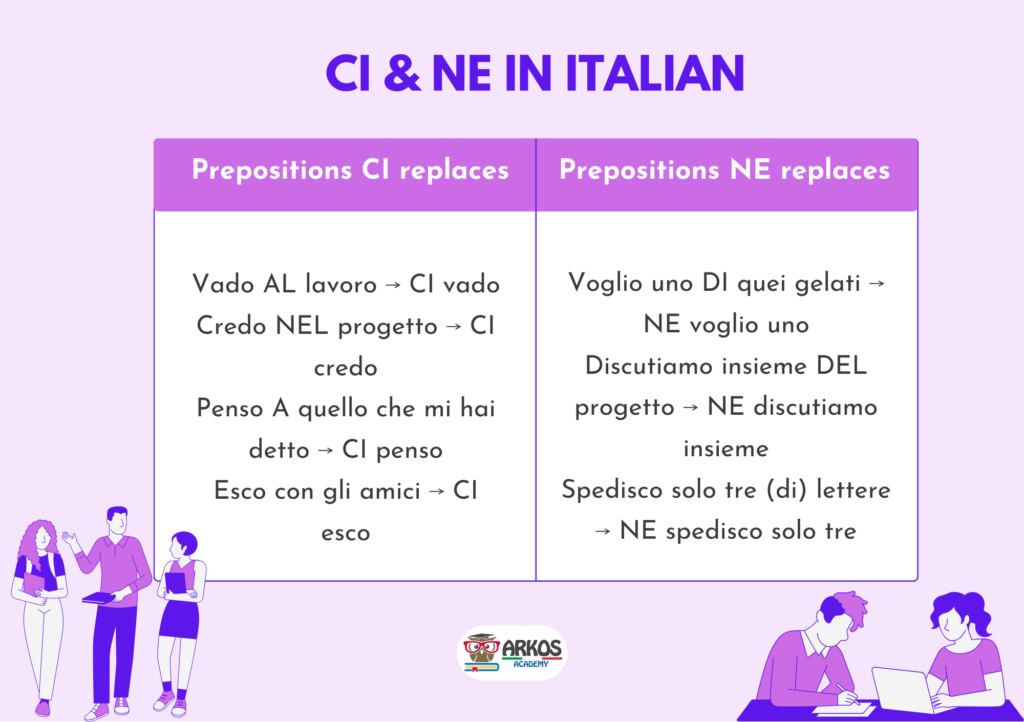
If you’re not yet fully confident with Italian prepositions, it’s worth reviewing them before going further — they’re the real key to understanding when to use ci and when to use ne. 👉 How to use Italian prepositions
Let’s see this in action.
When to use CI
1. To replace a place (= there)
When you’ve already mentioned a location, ci steps in so you don’t have to repeat it.
— Sei mai stato a Roma? — Sì, ci sono stato l’anno scorso! (Have you ever been to Rome? — Yes, I went there last year!)
2. With some verbs followed by a (to think about, to believe in, to count on…)
— Credi all’amore a prima vista? — Sì, ci credo! (Do you believe in love at first sight? — Yes, I believe in it!)
— Posso contare su di te? — Certo che ci puoi contare! (Can I count on you? — Of course you can count on it!)
3. As a reflexive/reciprocal or direct/indirect pronoun with noi
— A che ora vi svegliate di solito? — Ci svegliamo alle sette. (What time do you usually wake up? — We wake up at seven.)
— Vi vedete spesso? — Sì, ci vediamo ogni settimana. (Do you see each other often? — Yes, we see each other every week.)
4. C’è / Ci sono (there is / there are)
One of the most common uses — and one you probably already know!
— C’è un buon ristorante qui vicino? — Sì, ci sono due ottimi posti a cinque minuti a piedi! (Is there a good restaurant nearby? — Yes, there are two great spots five minutes away!)
When to use NE
1. To replace a quantity (ne partitivo)
When someone asks how many or how much, ne replaces the thing being counted.
— Quanti caffè bevi al giorno? — Ne bevo due. (How many coffees do you drink a day? — I drink two of them.)
— Vuoi dell’acqua? — Sì, grazie, ne prendo un po’. (Do you want some water? — Yes, thank you, I’ll have a little of it.)
2. To replace expressions with di (about, of…)
Ne usually replaces part of the sentence introduced by di.
— Hai parlato con Marco del tuo nuovo lavoro? — No, non ne ho ancora parlato. (Have you talked to Marco about your new job? — No, I haven’t talked about it yet.)
— Allora? Ti è piaciuto il film? Cosa ne pensi? — Ne penso benissimo, è fantastico! (What do you think of this film? — I think very highly of it, it’s fantastic!)
3. With pronominal verbs
Some verbs in Italian incorporate ne as a fixed part — these are called verbi pronominali. The most common example is andarsene (to go away, to leave):
— Dai, restiamo ancora un po’! — No, mi dispiace, me ne vado. (Come on, let’s stay a bit longer! — No, I’m sorry, I’m heading off.)
Pronominal verbs are a fascinating and very Italian feature of the language — we’ll explore them in depth in a future article.
When CI and NE Meet — CE NE
When ci and ne appear in the same sentence, ci becomes ce and the two work together as ce ne. This combination is extremely common in everyday Italian, so it’s well worth getting familiar with it!
Here’s how it works in practice:
— Quante persone ci sono alla festa? — Ce ne sono almeno trenta! (How many people are there at the party? — There are at least thirty of them there [=at the party]!)
— Hai messo abbastanza sale nella pasta? — Sì, ce ne ho messo quanto basta. (Did you put enough salt in the pasta? — Yes, I put in just the right amount of it [in the pasta].)
— C’è del pane in casa? — Sì, ce n’è ancora un po’. (Is there any bread at home? — Yes, there’s still a little of it left [at home].)
— Quante camere ci sono in quell’albergo? — Ce ne sono venti. (How many rooms are there in that hotel? — There are twenty of them [in that hotel].)
— Hai del caffè? — Mi dispiace, non ce n’è più. (Do you have any coffee? — I’m sorry, there’s none of it left [here].)
Notice the pattern: ce ne sono is the natural answer whenever someone asks quanti/quante ci sono? (how many are there?). It replaces both the location (ci) and the quantity (ne) in one neat little package.
💡 Quick tip: Don’t confuse c’è (there is) with ce n’è (there is some of it). The first introduces something new; the second refers back to something already mentioned.
The One Rule to Remember
If you forget everything else, keep this in your back pocket:
| Preposition in the original sentence | Particle to use |
|---|---|
| a / in / su / con | CI |
| di | NE |
Mini Dialogue: CI and NE in Real Life — Can You Spot Them?
Now it’s your turn to put your knowledge to the test! Read the dialogue below and try to identify every ci and ne.
For each one, ask yourself: what is it replacing? And why is it ci and not ne, or vice versa?
The answers and explanations follow — but try to work it out first! 🙂
Anna e Luca stanno pianificando un viaggio a Firenze. (Anna and Luca are planning a trip to Florence.)
Luca: Sei mai stata a Firenze?
Anna: Sì, ci sono andata due anni fa. È bellissima!
Luca: Anch’io voglio andarci. Conosci qualche buon ristorante?
Anna: Ne conosco uno ottimo vicino al Duomo. Si chiama Trattoria Mario.
Luca: Perfetto! E pensi che ci siano posti liberi senza prenotare?
Anna: Mah… non ne sono sicura. Meglio prenotare prima!
Luca: Hai ragione. Ci penso io!
Let’s analyse it together:
- “Sì, ci sono andata due anni fa” → ci replaces a Firenze (a place → preposition a → use ci ✅)
- “Anch’io voglio andarci“ → same idea, ci is attached directly to the infinitive verb (andarci = to go there)
- “Ne conosco uno ottimo” → ne replaces di ristoranti — “of them, I know a great one” (preposition di → use ne ✅)
- “pensi che ci siano posti liberi” → ci is part of ci sono (there are)
- “non ne sono sicura” → ne replaces di questo — she’s not sure about it (preposition di → use ne ✅)
- “Ci penso io!” → ci replaces a prenotare — “I’ll think about it” (preposition a → use ci ✅)
📌 Coming soon: Want to go even deeper? I’ll be publishing dedicated articles on ci and ne separately, with more examples, exercises and common mistakes to avoid. Keep an eye on the Arkos Academy blog!
Keep Practising
Ci and ne are two of the most frequently used particles in everyday Italian — native speakers use them constantly, often without even thinking about it. The best way to get comfortable with them is through exposure: listen to Italian conversations, watch Italian films or TV shows, and notice every time you hear them pop up.
Want some inspiration? Here are a few articles that can help you practise Italian in an enjoyable way:
If you’d like to find out which grammar points you need to work on most, take the free Italian level test — you’ll get instant feedback and a clear picture of where you are. 👉 Take the free Italian level test
And if you want to go deeper into Italian grammar with personalised guidance, take a look at the private lessons available at Arkos Academy — every lesson is tailored to your level and your goals.